Heat Exchanger Vacuum Brazing: Leak Testing and Process Qualification
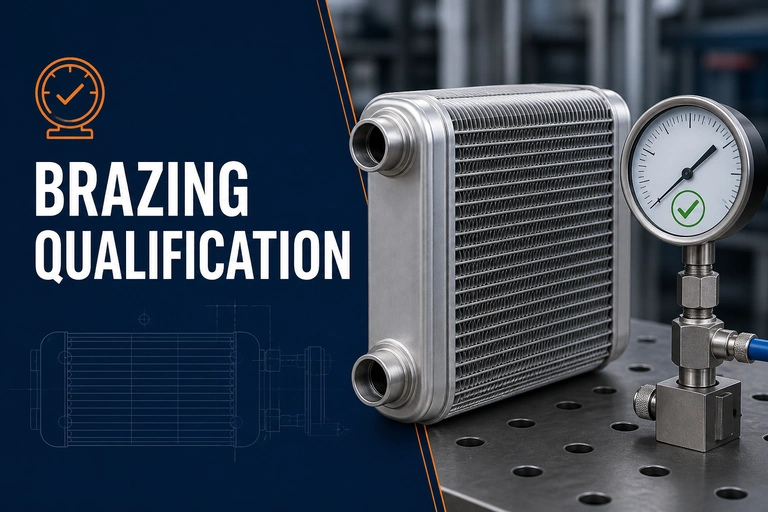
Heat exchanger vacuum brazing qualification links the furnace cycle, joint preparation, leak-test evidence and inspection criteria into one controlled release decision. Qualification is strongest when the acceptance evidence is defined before production hardware is loaded.
Heat Exchanger Vacuum Brazing Qualification: First Checks
A leak test tells you whether an assembly meets the defined leak requirement under the stated test method. It does not, by itself, qualify the brazing process. Reliable heat-exchanger production combines joint design, surface preparation, controlled loading, thermal-cycle evidence and a leak-test method with clear limits, media and sampling rules.
Define the evidence before the furnace is specified
Heat exchangers, cold plates, manifolds and fluid assemblies can have multiple quality requirements: joint integrity, leak tightness, clean flow channels, dimensional control, proof pressure, cleanliness and traceable production records. The required method and limit must be established by the product, service medium and customer specification. A generic “no leakage” statement is not a complete acceptance requirement.
Define the test fluid or gas, test pressure or vacuum condition, stabilization time, allowable loss or detector response, temperature condition, part condition, acceptance limit and sampling plan. These decisions determine whether a test result can be compared from one lot to the next.
Select a test method for the actual decision
| Method family | Useful purpose | Process discipline required |
|---|---|---|
| Pressure decay | Screen an assembly for pressure loss over a stated interval | Stable temperature, volume, pressure, timing and test-fixture condition |
| Bubble or immersion screening | Locate obvious leakage paths where compatible with the part | Clean/dry recovery procedure and defined visual inspection conditions |
| Tracer-gas or helium detection | Locate or quantify small leakage paths with suitable equipment | Controlled test setup, calibration and clean handling |
| Proof-pressure test | Confirm a structural pressure requirement | Safe fixture design, documented pressure and inspection controls |
Brazing and testing form one system
Do not use leak testing only as a final sorting station. A recurring leak pattern is useful process information. Compare the failure location with filler placement, joint clearance, oxide-control route, fixture contact, load position, thermal trace and post-braze handling. That makes it possible to correct a repeatable cause instead of increasing inspection alone.
The site’s Joint Design and Clearance Guide covers the capillary and fixturing decisions that should be fixed before qualification. The Vacuum Brazing Process Guide provides the broader process sequence.
Build a production-minded qualification plan
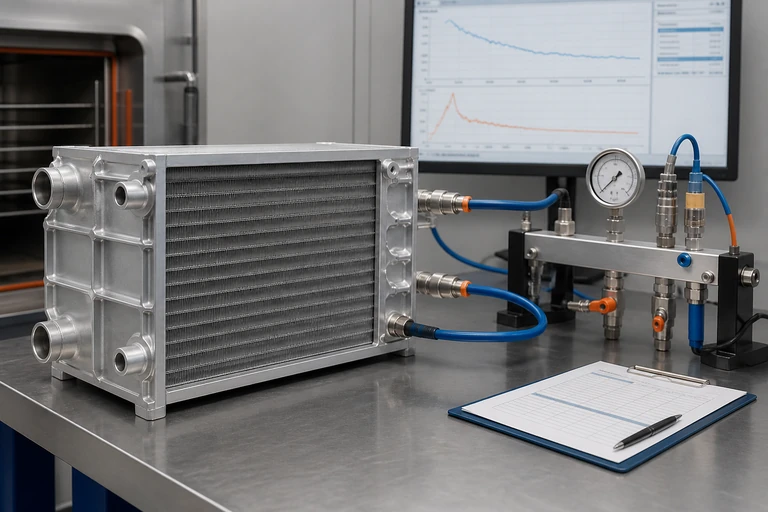
The qualification visual connects the assembled heat exchanger, test setup and retained evidence that support release decisions.
- Define the assembly drawing, material combination, filler and service requirement.
- Set the surface-preparation, fixture and load-map controls.
- Run the approved furnace cycle with recorded process conditions.
- Inspect joint fill and critical dimensions before destructive or non-destructive qualification steps.
- Apply the specified leak and pressure tests with calibrated, documented procedures.
- Freeze the validated process window and establish change control for material, cleaning, fixture, furnace and test-method changes.
For server and thermal-management applications, read Vacuum Furnace Solutions for Server Liquid Cooling and Heat Exchanger Manufacturing. It helps translate an end-use thermal problem into a manufacturing discussion.
For heat-exchanger brazing, furnace specification should include the assembly envelope, joint/filler system, thermal profile, clean-process requirement, loading method, cooling, traceability and the qualification evidence expected after brazing. The quality plan should influence the equipment brief from the first RFQ. Start with Vacuum Furnace Systems to compare furnace families, then use the Vacuum Brazing Furnace system family when the process includes different exchanger geometries, joint materials or qualification routes.
Where the exchanger assembly is aluminum-based, review the High Vacuum Aluminum Brazing Furnace to relate the load, clean-process requirement and leak-test qualification plan to a specific equipment configuration.
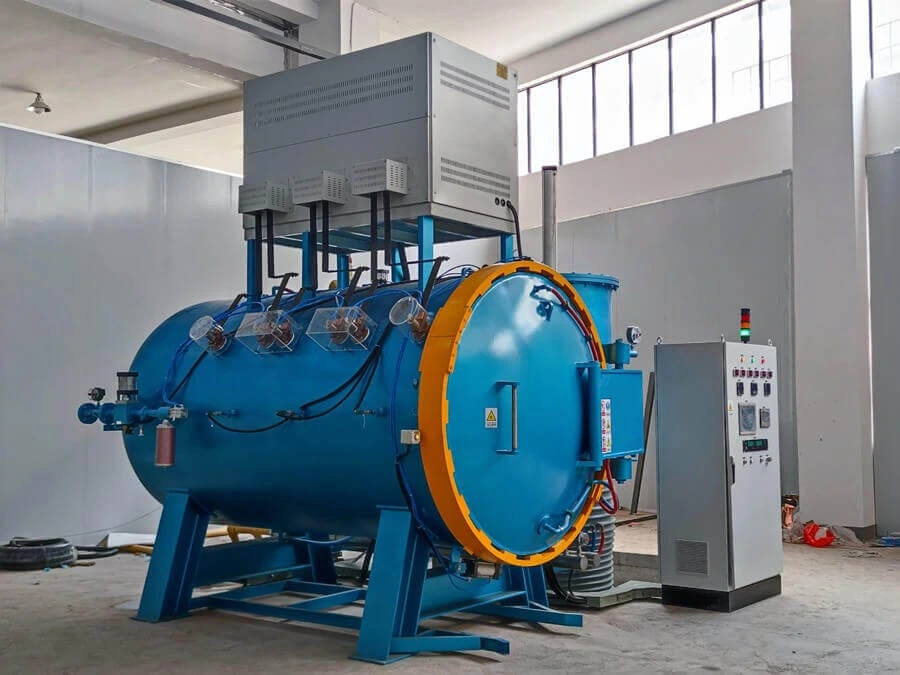
High Vacuum Aluminum Brazing Furnace
Equipment design should be reviewed together with the part, fixture, furnace cycle and quality-verification plan for the target heat-exchanger assembly.
- Load and work-zone configuration
- Process controls for qualified brazing
- Acceptance and data-recording requirements
What to include in your enquiry
Supply the end-use and test requirement as well as the furnace inputs.
- Assembly drawing, materials, filler and service medium
- Required leak-test and proof-pressure method, limits and records
- Joint design, cleaning route, fixture and load arrangement
- Thermal cycle, production volume and target cycle time
- Dimensional, cleanliness and traceability requirements
Technical references
- AWS C3.7M/C3.7 — Specification for Aluminum Brazing — official AWS specification covering aluminum brazing procedure and inspection requirements.
- ASTM E498/E498M — Tracer-Probe Leak Testing — official ASTM practice for tracer-gas leak location and evaluation where a leak-test method is part of qualification.