A configurable vacuum hot press platform that matches work zone, tooling clearance, temperature, vacuum system and hydraulic loading to diffusion bonding and selected vacuum brazing applications.
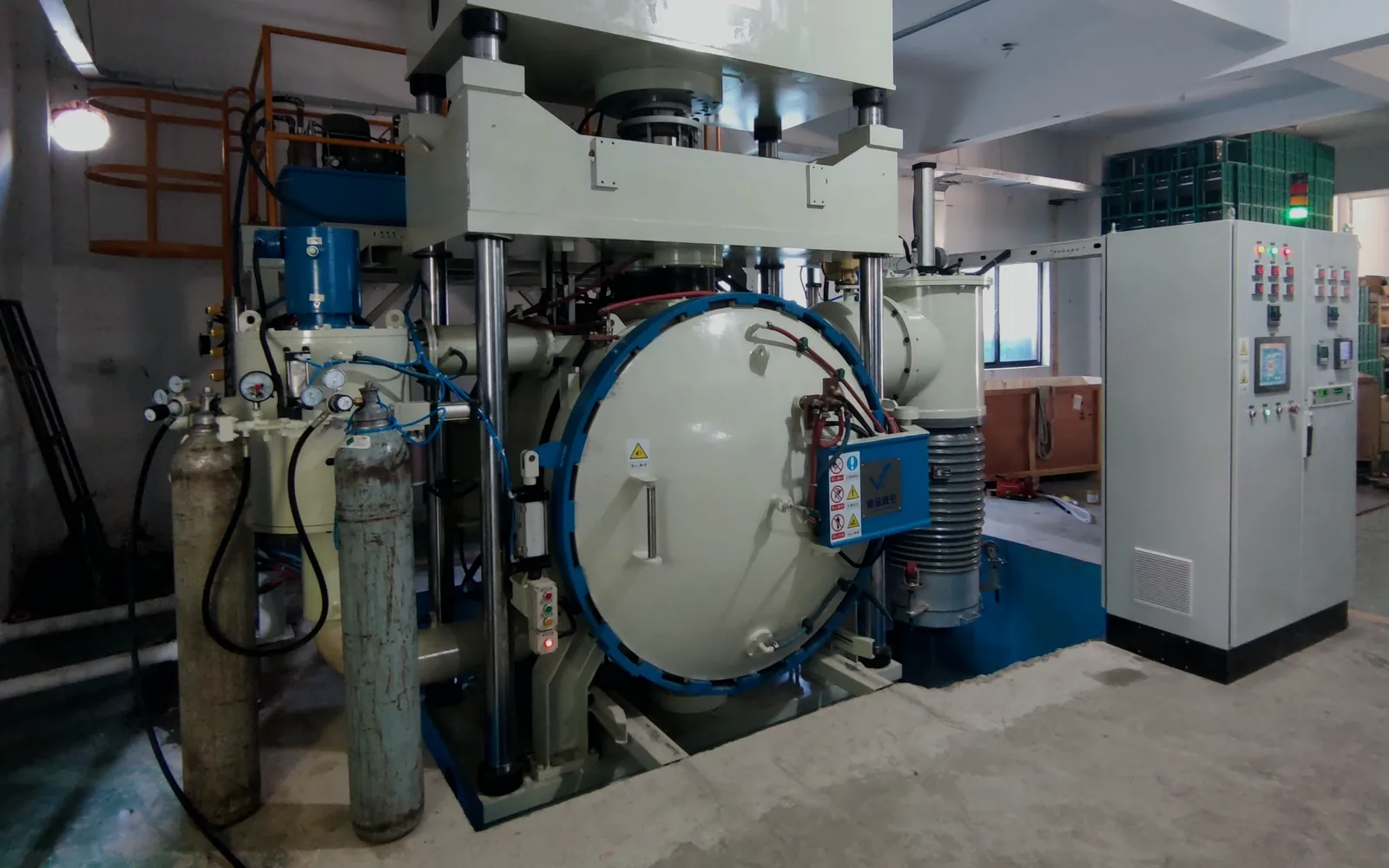
The VTM platform combines high vacuum, precise thermal control and hydraulic pressure for clean, repeatable diffusion bonding and vacuum brazing of demanding metal assemblies.
Diffusion bonding and vacuum brazing are used when conventional welding may introduce distortion, oxidation, filler contamination or excessive residual stress.
Vacuum environment reduces oxidation and supports clean bonding interfaces for titanium alloy, stainless steel and dissimilar metal assemblies - the core working principle of a vacuum diffusion bonding furnace.
200T hydraulic loading, 100 mm press stroke and precision plate alignment support stacked plates and structural parts.
Suitable for vacuum brazed joints where clean surfaces, controlled heating and low-oxidation processing are critical - see the full vacuum brazing furnace range.
The correct furnace brief starts with the joint mechanism. Diffusion bonding relies on prepared interfaces, heat and compressive loading; vacuum brazing uses a compatible filler system and normally requires much less joining pressure.
On a narrow screen, swipe horizontally to review all columns.
| Decision Point | Diffusion Bonding Route | Vacuum Brazing Route | Information Needed Before Selection |
|---|---|---|---|
| Joint mechanism | Solid-state interface formation under controlled heat, time and pressure | Filler alloy flows through the prepared joint under a controlled vacuum thermal cycle | Joint drawing, interface area, gap and allowable filler |
| Pressure requirement | Hydraulic load, tool stiffness, plate alignment and pressure distribution are primary sizing inputs | Fixturing and joint restraint matter, but full press capacity may not be required | Required force or pressure, loaded area, stack height and tooling mass |
| Material route | Direct or interlayer-assisted material combinations selected for compatibility | Base materials, filler alloy and surface preparation selected as one coordinated system | Material grades, interlayer/filler data and prior process evidence |
| Typical geometry | Plate stacks, internal channels, laminated tools and pressure-accessible assemblies | Heat exchangers, cooling plates, honeycomb structures and filler-compatible assemblies | Part envelope, channel layout, contact area and loading orientation |
| Acceptance evidence | Temperature, vacuum and pressure records plus project-defined joint verification | Temperature and vacuum records plus project-defined braze and leak verification | Test standard, witness points, sample plan and required reports |
Send the material pair, joint drawing, loaded area, stack height, target process window and acceptance method. SYNHTE can then determine whether a press-equipped VTM platform or another vacuum brazing configuration is the more relevant route.
Compare the VTM working-zone options, vacuum performance, thermal capability and hydraulic loading for precision diffusion bonding and vacuum brazing applications.
On a narrow screen, swipe horizontally to review all columns.
| Parameter | VTM-555 | VTM-855 | Application Benefit |
|---|---|---|---|
| Furnace type | Horizontal single-chamber, double-door | Vacuum diffusion bonding furnace | Pressure-assisted vacuum joining platform |
| Joining materials | Stainless steel, titanium alloy | Titanium alloy | Titanium, stainless steel, precision alloy assemblies |
| Working vacuum | ≤5.0×10⁻³ Pa | ≤5.0×10⁻³ Pa | High-vacuum thermal joining |
| Pressure rise rate | ≤0.3 Pa/h, measured 0.024 Pa/h | ≤0.3 Pa/h, measured 0.024 Pa/h | Leak-tight chamber performance |
| Maximum temperature | 1200°C | 1200°C | Diffusion bonding and vacuum brazing range |
| Uniform hot zone | 500×500×500 mm | 800×500×500 mm | Small and medium work envelopes |
| Temperature uniformity | ≤±5°C at 950°C, 9-point empty test | ±5°C empty / ±10°C with press head | Stable thermal field for stacked parts |
| Control accuracy | ≤±1°C | ≤±1°C | Repeatable process control |
| Pump-down time | 28 min to specified test point | 27 min to 4.0E-3 Pa | Fast cycle preparation |
| Heating power | 150 kW | 180 kW | Sized to hot-zone volume |
| Total installed power | 200 kW | 250 kW | Industrial power-class equipment |
| Hydraulic pressure | 200T | 200T | High-force diffusion bonding |
| Pressure fluctuation | ±1% FS | ±1% FS | Stable loading through working range |
| Press stroke | 100 mm | 100 mm | Flexible tooling and stacked fixtures |
| Press plate flatness | ≤0.1 mm | ≤0.1 mm | Uniform surface contact |
| Upper / lower plate parallelism | ≤0.2 mm | ≤0.2 mm | Consistent pressure transfer |
| Press plate displacement precision | ≤0.04 mm | ≤0.04 mm | Fine movement control during bonding |
| Cooling pressure | ≤0.08 MPa | ≤0.08 MPa | External circulation cooling support |
| Control mode | Automatic / manual interlock control | Automatic / manual interlock control | Production and setup operation modes |
Built for stable temperature, vacuum and pressure control in high-value joining applications.
The VTM chamber integrates an insulated door, high-temperature hot zone and practical working space for stable, repeatable vacuum joining.
The open-chamber layout provides clear access to the insulated door, hot zone and loading space for efficient production setup.
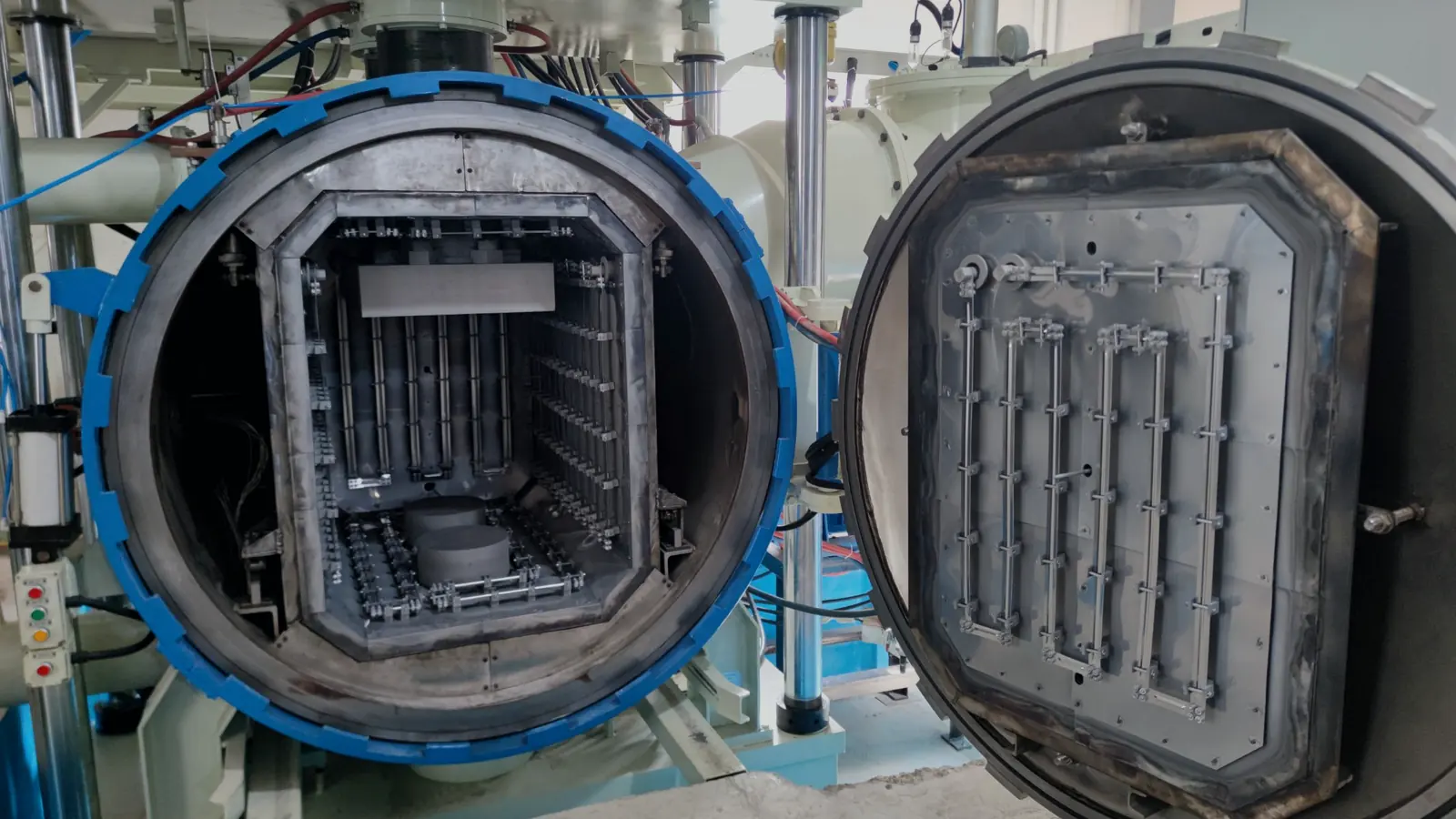
Choose a compact or extended working zone for your part size, then configure pressure, heating, pumping and controls around the requirements of your vacuum joining process.
Hot zone: 500×500×500 mm. Heating power: 150 kW. Hydraulic pressure: 200T. Suitable for stainless steel and titanium alloy parts, R&D tooling, compact exchanger plates and smaller batch structural assemblies. This vacuum diffusion bonding furnace class handles full-cycle bonding process from pump-down to controlled cooling.
Compact production formatHot zone: 800×500×500 mm. Heating power: 180 kW. Hydraulic pressure: 200T. Suitable for longer plate stacks, titanium alloy components, larger cooling-channel structures and medium-size bonded assemblies.
Extended work lengthAvailable with smaller or larger work envelopes, matched hydraulic loading, pump groups, fixture clearance, control architecture and thermal process configuration for customer-specific bonding lines, aerospace hardware and thermal management parts.
Engineered to process envelopeSix engineering inputs connect the part geometry and process targets with the work zone, thermal system, pressure program, vacuum system and handover scope.
Base-material grades, direct or interlayer-assisted joint, interface area, surface route and allowable filler.
Maximum part dimensions, loaded stack height, fixture mass, loading direction and pressure-tool clearance.
Target temperature range, ramp and hold logic, temperature-uniformity requirement and controlled-cooling boundary.
Required force or interface pressure, loaded area, application stage, hold stability and movement-control requirement.
Required vacuum level, pump-down expectation, acceptable pressure-rise test, cooling water, power and plant interfaces.
FAT/SAT witness points, recorded channels, sample testing, documentation, operator training and site acceptance.
The furnace combines high-vacuum pumping, hot-zone uniformity, press accuracy, plate geometry and process automation into one production-ready system.
Working vacuum down to ≤5.0×10⁻³ Pa helps reduce oxidation and contamination during diffusion bonding and brazing cycles. A vacuum diffusion bonding furnace with this vacuum level is suitable for aerospace titanium joining and precision heat exchanger assembly. See also our vacuum brazing furnace for flux-free joining cycles.
Clean interface qualitySuitable for titanium alloy, stainless steel and nickel-based joining processes. For sintering and powder metallurgy applications, see our vacuum sintering furnace.
Diffusion and brazing rangePressure-assisted bonding improves interface contact and supports plate stacks, laminated structures and tooling assemblies.
Controlled force loadingFlatness ≤0.1 mm, parallelism ≤0.2 mm and displacement precision ≤0.04 mm support more uniform bonding pressure.
Better contact uniformityThe VTM furnace control system includes multiple independent interlock loops. Each protects against a specific risk scenario during high-temperature, high-vacuum, high-pressure operation.
Automatic heating cut-off at ≥1210°C. Independent thermocouple loop, separate from the main control thermocouple.
If vacuum degrades beyond the setpoint during bonding, the system automatically holds hydraulic pressure and triggers an alarm. Optional auto-vent with inert gas.
Pressure automatically releases when hydraulic load exceeds 210T (105% of rated capacity). Protects press frame, platens and hydraulic system.
Low flow or low pressure (≤0.08 MPa trigger) generates an alarm and initiates controlled power reduction. Prevents overheating of chamber walls and heating elements.
Built-in compressed air storage tank provides ≥30 minutes of pneumatic supply during power outages. All valves maintain position; no uncontrolled movement of press or vacuum valves.
Furnace door cannot be opened while chamber vacuum is below safety threshold. Vacuum pumps cannot start while door is open. Dual interlock on door switch and vacuum sensor.
VTM vacuum diffusion bonding and brazing furnaces are suitable for components that need clean joints, tight geometry, internal channels or high-temperature service performance.
Titanium alloy panels, structural assemblies and high-integrity joined parts. See the full aerospace vacuum furnace application range.
Plate stacks, microchannel structures, cold plates and compact thermal management parts.
Metal molds, laminated tools, cooling-channel inserts and process fixtures.
Clean metal joining for specialist instruments, lab components and validated R&D parts.
For dissimilar metal combinations or multi-material assemblies, SYNHTE also offers vacuum brazing furnaces and hot-press diffusion bonding configurations - alongside the standard VTM diffusion bonding furnace range.
The chamber layout accommodates pressure tooling, fixtures and practical working space for precision vacuum joining.

The chamber provides space for fixtures, pressure tooling and loading arrangements used in precision joining applications.
The VTM platform supports a broad range of metallic material systems used in aerospace, thermal management, precision tooling and high-integrity structural assemblies.
On a narrow screen, swipe horizontally to review all columns.
| Base Material | Intermediate Layer | Typical Process Temp | Typical Applications |
|---|---|---|---|
| Titanium & Nickel Alloys | |||
| TC4 Titanium Alloy | Ti-6Al-4V foil | 920-950°C | Aerospace blades, structural panels |
| 316L Stainless Steel | - (direct bond) | 1000-1050°C | Heat exchanger plates, bellows |
| Stainless Steel + Titanium | Nb foil | 900°C | Transition joints, hybrid assemblies |
| Inconel 718 | - (direct bond) | 1100°C | Aero engine components |
| Steel & Dissimilar Metal Combinations | |||
| Carbon Steel + SS | Ni foil | 1050°C | Overlays, clad plates |
| Titanium + Copper alloy | TiCu interlayer | 880-920°C | Electrical transition joints |
The VTM platform coordinates chamber vacuum, heating, hydraulic pressure and controlled cooling to support repeatable joining results.
Practical chamber access supports efficient loading of parts and pressure tooling.
A clean vacuum environment helps protect critical joining interfaces.
Programmable heating profiles support uniform temperature through the work zone.
Coordinated press loading supports consistent contact across complex assemblies.
Managed cooling completes the cycle while protecting part quality.
A clear FAT/SAT plan brings vacuum, thermal, hydraulic, safety and handover evidence into one coordinated review path.
Ultimate or working-vacuum method, pump-down test point, pressure-rise method, instrument identification and recorded result.
Temperature-uniformity method, control accuracy, empty or loaded condition, sensor layout and cycle-data export.
Force/pressure range, hold stability, movement resolution, plate alignment, stroke and applicable tooling condition.
Door/vacuum, cooling-water, over-temperature, hydraulic overload, power-failure and alarm-response checks.
Customer sample or witness coupon, destructive or non-destructive test options, pass criteria and recorded results.
Utilities, installation boundary, SAT repeat checks, operator training, manuals, spare-parts scope and final records.
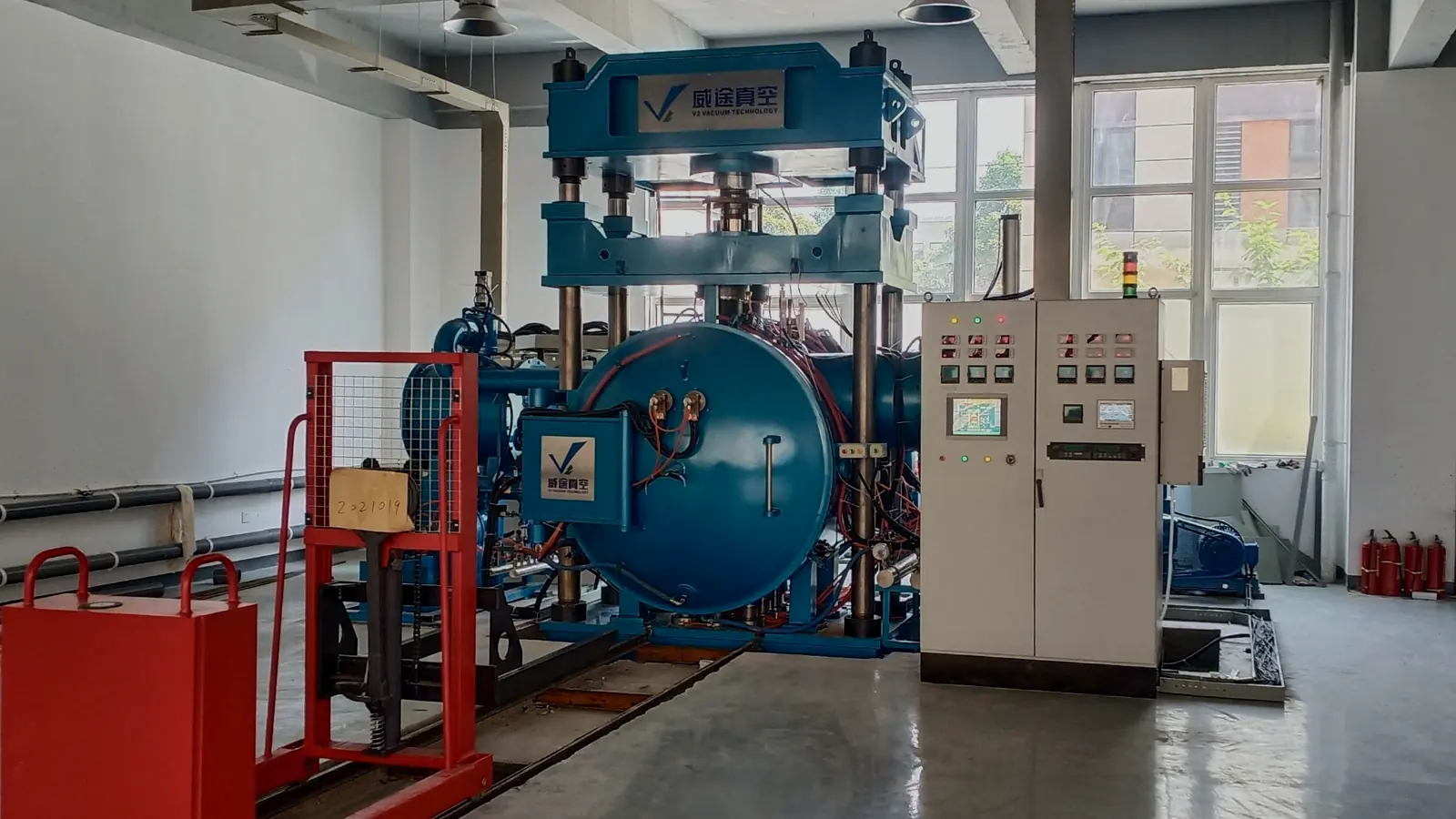
The chamber and adjacent control cabinets bring vacuum, temperature, hydraulic pressure and cooling management together in one coordinated system.
The control architecture coordinates loading, chamber vacuum, temperature, hydraulic pressure and cooling through each joining cycle.

Compare the VTM-555 and VTM-855 work zones, heating power, hydraulic loading and movement control with your part, tooling and production requirements.
VTM system configurations combine a practical working zone with high-temperature capability, hydraulic loading and precise press movement.
Send the assembly, process and site information below so the engineering team can match the work zone, tooling, vacuum system, hydraulic loading and services to your application.
Explore SYNHTE vacuum furnace systems for brazing, heat treatment and related precision thermal-processing applications.
SYNHTE supports your system from project planning through installation, commissioning and long-term service.
VTM-555 and VTM-855 systems are available for compact and extended vacuum joining applications.
Each system is prepared for reliable vacuum, heating, hydraulic and control performance before shipment.
SYNHTE provides installation, commissioning and operator training for a smooth production start.
Warranty and service support are available for core furnace, vacuum, hydraulic and control components.
Remote and on-site technical service is available to keep your system operating efficiently.
Our team can help configure the furnace platform around your materials, part geometry and joining objectives.
Share the material pair, joint drawing, loaded work envelope, pressure requirement, thermal window, vacuum target and acceptance plan. The engineering team can then review the relevant VTM configuration and open technical questions.
Download the current reference document or compare all available SYNHTE technical resources.