Vacuum Furnace FAT and SAT Checklist: What to Verify Before Acceptance
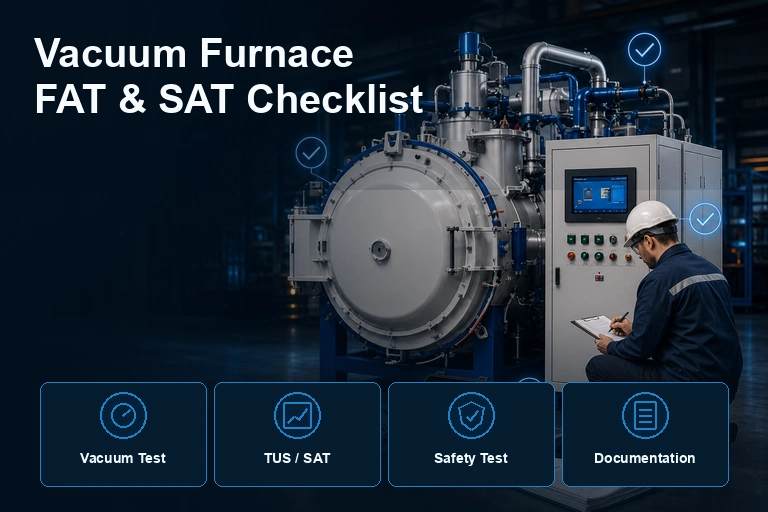
A vacuum furnace purchase should be accepted against agreed evidence, not a demonstration that the machine heats up. A clear Factory Acceptance Test (FAT) and Site Acceptance Test (SAT) reduce misunderstandings about performance, utilities, documentation and responsibility before the equipment reaches production.
| Acceptance area | FAT focus | SAT focus | Required record |
|---|---|---|---|
| Vacuum and thermal performance | Factory test under agreed conditions | Confirmation after installation where specified | Test method, raw data and pass/fail result |
| Utilities and interfaces | Simulated or supplier-side verification | Actual water, power, gas, exhaust and network interfaces | Measured site values and deviations |
| Safety and controls | Logic, alarms, interlocks and emergency functions | Integrated test with site systems | Signed cause-and-effect checklist |
| Documents and training | Draft/final manuals, drawings and parts lists | Site handover and operator/maintenance training | Controlled document index and attendance record |
The exact checklist must match the process and contract. A brazing furnace for a high-value heat exchanger, a gas-quenching furnace and a diffusion-bonding press require different acceptance items.
Define the vacuum furnace FAT and SAT basis before fabrication
Freeze the key requirements in the technical agreement: work-zone dimensions, temperature range, uniformity requirement, vacuum capability, leak-up or pump-down criterion, cooling/quench configuration, load mass, cycle time, utilities, safety functions, controls, data recording and included accessories. Identify the governing test method, ambient conditions, instruments and permitted tolerances.
Where a customer requires AMS2750, CQI-9 or a proprietary standard, name the controlled revision and clarify whether the supplier’s scope includes survey/test execution, instrumentation, report format or only equipment capability. This prevents a generic statement of “compliance” from being mistaken for a complete qualification package.
Typical FAT evidence
The FAT is normally performed at the manufacturer’s facility. The agreed evidence may include:
- Visual and dimensional verification of the chamber, hot zone, door/lift, piping and electrical cabinet.
- Review of material certificates, component list, drawings and as-built configuration.
- Functional checks of heating zones, controllers, over-temperature protection, vacuum sequence, alarms and interlocks.
- Demonstrated vacuum performance using the agreed method and instrumentation.
- Cooling-water, gas-quench, blower and heat-exchanger checks where supplied.
- Demonstration of the agreed test cycle or representative load simulation.
- Control-system screens, recipe management, data logging, alarm history and export capability.
- Safety-device function tests and written evidence of the results.
Photographs, signed test records and the exact serial/configuration identity should accompany the FAT report. A video is useful supporting evidence but should not replace measured data.
What changes at SAT
The SAT confirms that the furnace performs correctly after transport, installation and connection to the customer’s utilities. It should verify installation condition, site water and gas supply, electrical quality, exhaust/ventilation interfaces, safety systems, control communication, operating training and the agreed repeat test if required.
Do not assume a factory result transfers unchanged to site. Utility quality, site piping, cooling capacity, foundation/leveling and local gas supply can affect the result. Record the actual site conditions in the SAT report.
Include documents that support production
Ask for operating, maintenance and safety manuals; electrical and piping drawings; spare-parts list; calibration certificates where included; software/parameter backup process; utility requirements; preventive-maintenance plan; training record; warranty/support contacts; and FAT/SAT reports. Define the language and delivery format before shipment.
Acceptance is the start of process qualification
Equipment acceptance proves that the delivered machine meets the agreed capability. It does not by itself qualify every product process. After SAT, develop or transfer the approved recipes, fixtures, loading rules, pyrometry/thermal validation and inspection plan required for each part family.
When requesting a quote from SYNHTE, include your proposed FAT/SAT template along with process data. If you do not yet have one, share the materials, process, work-zone, temperature, vacuum, cooling, documentation and customer-standard requirements so the acceptance plan can be defined early.
Acceptance evidence must follow the process family. A vacuum brazing furnace emphasizes cleanliness, leak performance and brazing-cycle uniformity; a vacuum heat treatment furnace adds quench performance and metallurgical verification; and a vacuum sintering furnace may require atmosphere, binder-management and density evidence. A generic FAT checklist should therefore be converted into a process-specific acceptance plan.
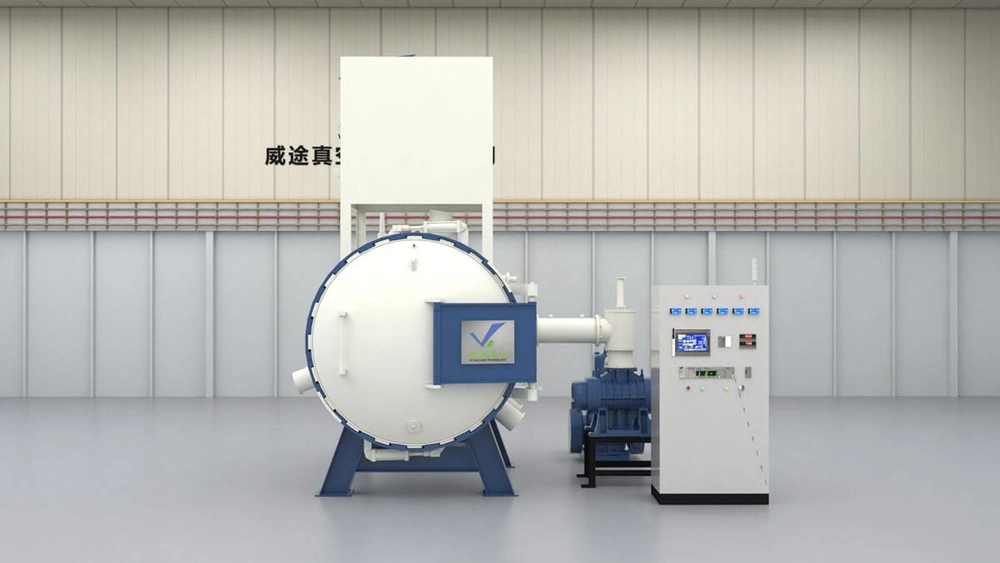
SYNHTE Vacuum Furnace Systems
Different furnace processes require different acceptance evidence. Start with the relevant system family, then add process-specific vacuum, temperature, cooling, atmosphere, force, data and safety tests to the purchase specification.
- Process-specific acceptance tests
- Utility and site-interface checks
- Documented FAT and SAT evidence
What to include in your enquiry
These details let the engineering team respond with a relevant configuration instead of a generic catalogue answer:
- Furnace type, work zone and process specification
- Required vacuum, uniformity, cooling and atmosphere performance
- Utilities and site interface conditions
- Customer standards, witness points and document language
- Preferred FAT/SAT template and acceptance authority
Put measurable acceptance criteria into the quotation stage
Attach your FAT/SAT template or list the required vacuum, temperature, cooling, controls, documentation and training evidence. Send the acceptance requirements to SYNHTE so they can be addressed before fabrication.