Large-Load Vacuum Sintering Qualification for Bottom-Loading Furnaces
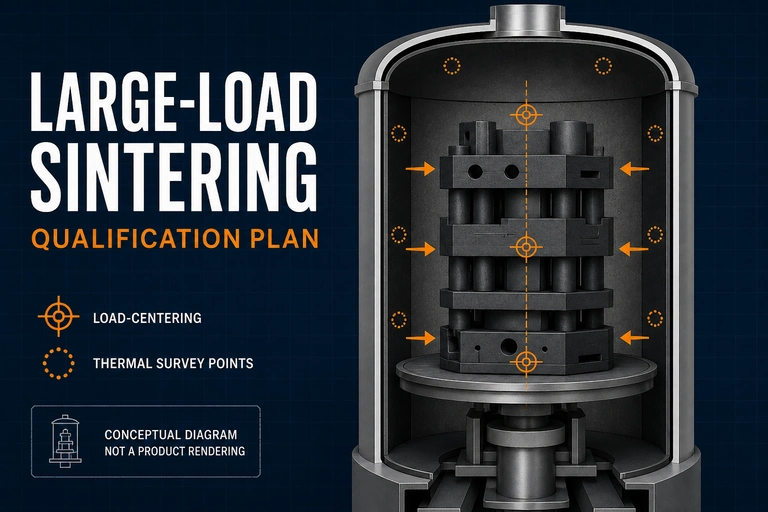
Large-load vacuum sintering qualification is the process of proving that the approved load envelope, tooling, furnace cycle, atmosphere sequence, and handling method produce acceptable parts throughout the usable zone. Bottom loading can simplify the movement of tall or heavy fixtures, but it does not remove the need to control load centering, thermal shadowing, gas access, binder removal, shrinkage, and safe platform travel. A sound plan starts with the material-specific process and measurable part requirements, then uses the furnace configuration to make that process repeatable.
Define the load envelope before running a qualification batch
The load envelope is more than maximum weight. Record overall height and diameter, total mass, number of levels, part geometry, green density range, binder system, setter and fixture materials, spacing, centre-of-gravity limits, and the location of the most thermally shielded parts. A tall stack may be mechanically stable but create long vapor paths or uneven radiative exposure. A wide, dense layer may obstruct gas movement. Qualification should cover the configuration expected to be hardest to process within the proposed operating window.
Separate material requirements from equipment assumptions. Final density, dimensional change, carbon or oxygen control, microstructure, strength, appearance, and allowable defects depend on the product and specification. Define which outputs are mandatory and how they will be sampled. The furnace recipe then becomes one controlled input among several, not a guarantee of material performance.
| Control area | Record before the run | Evidence after the run |
|---|---|---|
| Mechanical envelope | Mass, dimensions, centre of gravity, fixture interfaces | Stable travel, no contact, no fixture movement |
| Thermal envelope | Stack geometry, shielding, representative sensor positions | Time-temperature records and part results by location |
| Atmosphere path | Binder load, purge or vacuum stages, gas access paths | Pressure trend, exhaust behavior, surface and chemistry results |
| Product outcome | Sampling map and acceptance criteria | Density, dimensions and specified material tests |
Control platform travel, centering, and fixture stability
A bottom-loading arrangement moves the load platform vertically into the hot zone. The qualification plan should verify clearances throughout travel, positive location at the processing position, sealing interfaces, interlocks, and the stability of the fixture under acceleration and stopping. Keep the centre of gravity inside the approved handling envelope and document how the load is restrained without creating unacceptable thermal barriers. Operators need a repeatable method for confirming platform alignment before every run.
The featured image is deliberately a conceptual diagram rather than a product rendering. Actual chamber geometry, support arrangement, and allowable load must come from the approved machine documentation. During commissioning, observe travel with a representative cold load and use the supplier's safety procedure. Never place personnel below or inside the motion envelope, and never bypass an interlock to speed a trial.
Prove thermal and atmosphere behavior across the full stack
Radiation dominates many high-temperature vacuum processes, so line of sight, fixture emissivity, part spacing, and shielding influence heat transfer. Large loads can develop different heating rates between exposed outer positions and protected internal positions. Place qualification sensors or representative witness pieces according to an approved engineering plan and relate their locations to the load drawing. The soak definition should be tied to the slowest relevant position or another justified process criterion, not only to the furnace control reading.
Binder removal and gas evolution require equal attention. Vapor pathways, pumping stages, traps, purge sequences, and partial-pressure gas settings must suit the material system. A dense stack that works for final sintering may be unsuitable during binder removal if vapors cannot leave reliably. The vacuum sintering furnace centre explains the broader process family, while the Bottom-Loading Vacuum Sintering Furnace page provides current equipment context for vertically handled large loads. Use those pages to frame supplier questions, not to replace material trials.
Record pressure against time, valve and pump transitions, gas identity, flow or pressure state, relevant trap condition, and alarm events. Unexpected pressure shoulders can indicate continuing outgassing, excessive binder load, leakage, or a sequence mismatch, but diagnosis requires corroborating evidence. Do not assign a universal pressure limit without the process specification and furnace configuration.
Map part results to load position before scaling up
A qualification batch should preserve position information. Identify levels, radial zones, and representative part orientations so density, shrinkage, distortion, chemistry, or microstructure results can be traced back to the load map. Pooling every result into one average can hide a weak region. Review centre versus edge, top versus bottom, and exposed versus shielded positions using the acceptance method required for the material.
Scale-up should proceed by controlled changes. Increasing height, layer count, fixture mass, or binder inventory can change heating and gas removal even when the setpoint recipe is unchanged. Establish an approved operating envelope and define which changes need review. Confirmation runs should include normal production variability in green parts and tooling rather than only carefully selected samples.
Keep the recipe revision, furnace identity, qualification status, platform and fixture drawing, load map, sensor or witness map, raw cycle record, atmosphere record, maintenance status, inspection results, and deviations in one evidence package. Photographs of each layer before stacking can make later analysis much faster. If a result fails, preserve its exact location and process data before changing the recipe; otherwise the team may lose the causal signal.
Equipment questions that matter for large-load sintering
For a bottom-loading project, ask about usable hot-zone dimensions rather than vessel dimensions, approved platform load and centre of gravity, positioning repeatability, sealing and interlocks, hot-zone construction, heating-zone control, sensor access, vacuum and partial-pressure capability, binder-management provisions, cooling method, service clearance, and data recording. Review how fixtures are loaded outside the furnace and how the operator remains clear of lifting and closing hazards.
Share the material family, binder system, green-part geometry, maximum and typical load drawings, fixture materials, process stages, desired atmosphere, acceptance tests, throughput, and facility constraints. This information lets the supplier evaluate whether the large-load route is technically appropriate and which evidence should be generated during factory and site acceptance.
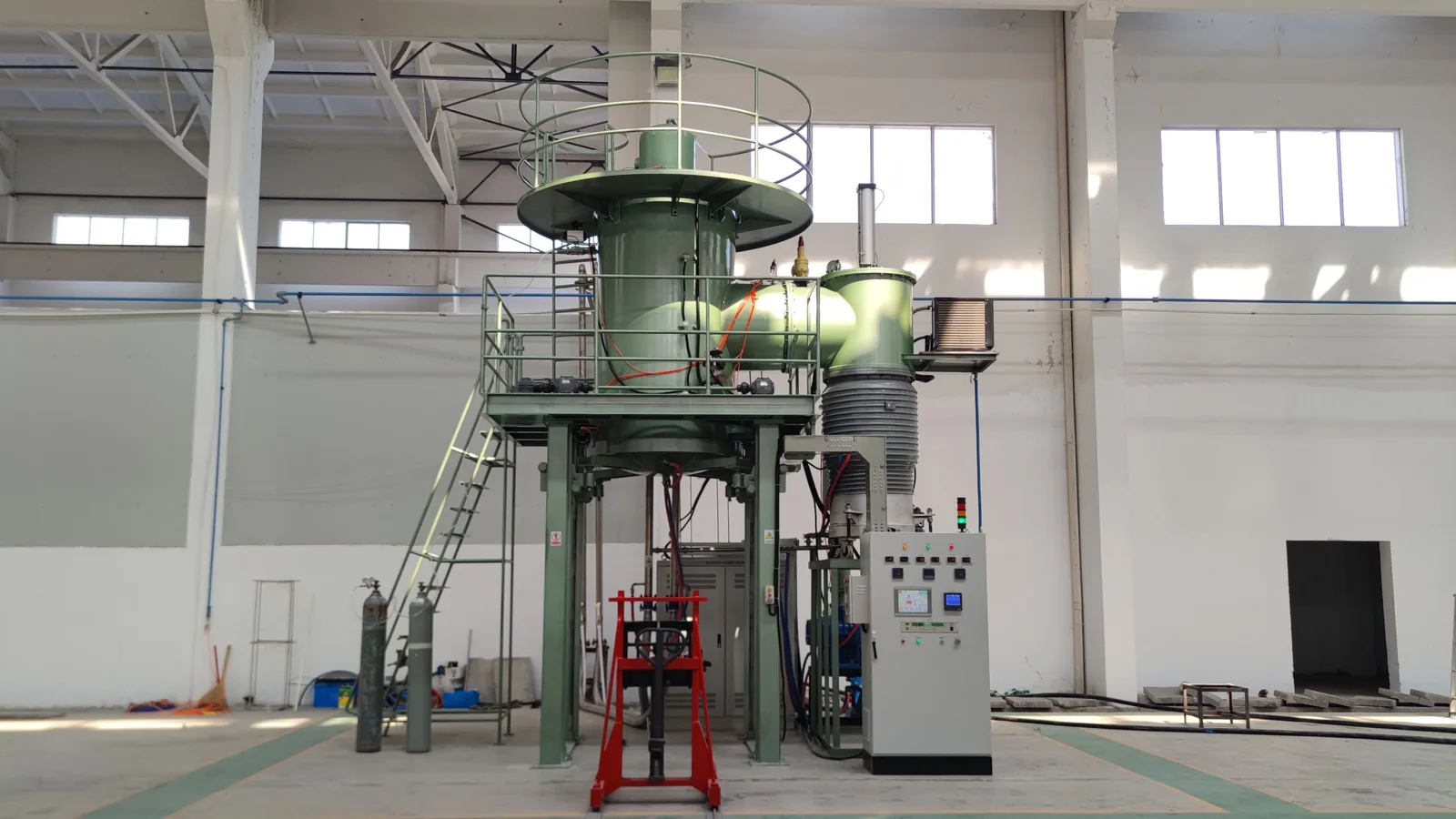
Bottom-Loading Vacuum Sintering Furnace
This furnace layout is intended for vertically handled tall or heavy fixtures where controlled platform travel, load centering, usable hot-zone capacity, atmosphere management, and safe external loading must be evaluated together. The approved load envelope and process evidence still need to be qualified for the actual material and tooling system.
What to include in your enquiry
- Material grade, starting condition, and controlling specification
- Part and fixture drawings, load mass, and production arrangement
- Process stages, atmosphere or vacuum requirements, and cooling route
- Acceptance tests, sampling locations, and traceability expectations
- Typical batch volume, cycle target, utilities, and site constraints
Technical references
- ISO 3369:2006 — Impermeable sintered metal materials and hardmetals — Determination of density. Use this current density method only when it matches the material class and controlling product specification; permeable sintered materials and other material systems require their applicable test standards.