Vacuum Hot Pressing for Technical Ceramics: Qualification Plan
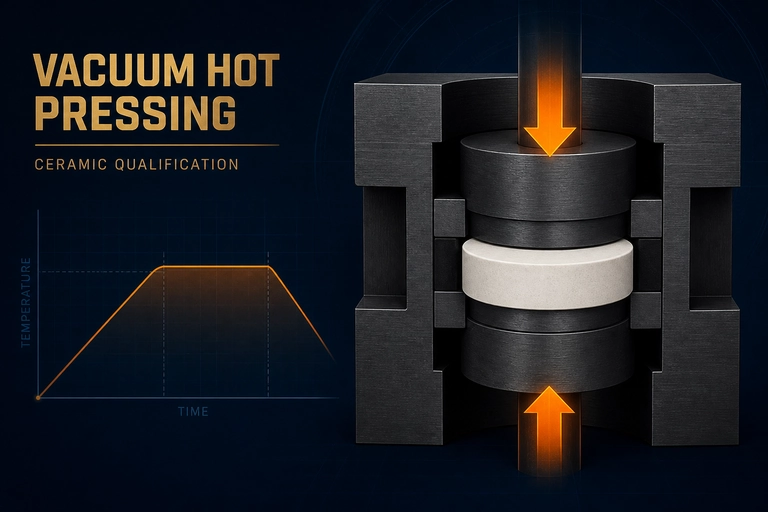
Vacuum hot pressing for technical ceramics is evaluated when temperature alone does not provide a sufficiently controlled route to densification, porosity reduction or part geometry. It couples heat, axial force and a controlled vacuum or atmosphere in one recipe, so the material outcome depends on the interaction of all three variables rather than on a single peak-temperature number.
For technical ceramics, an equipment decision should therefore follow a qualification plan. The plan translates material behaviour, powder or preform condition, die-stack geometry, pressure history, thermal profile and inspection criteria into evidence that can be reviewed before the process is transferred from development work to a repeatable production window.
Define the densification decision before selecting a furnace
Start by writing the result that must be proven. It may include density, open-porosity limit, geometry retention, surface condition, grain-growth constraint, mechanical response or electrical and thermal properties. The planned tests should identify both specimen condition and measurement method, because a density value alone may not reveal a cracking, warpage or tooling-contact issue.
Next, separate the variables that are material-specific from those that are equipment-specific. Material chemistry, particle characteristics, green-body preparation and acceptable thermal exposure define the process window. Chamber atmosphere, temperature control, press force, displacement monitoring, die accommodation and data recording determine whether that window can be repeated with the proposed tooling and load.
This approach protects procurement as well as process development. It avoids requesting a nominal maximum temperature or press tonnage without first defining useful hot-zone size, actual die stack, target pressure at the workpiece and the evidence that will release a part family.
Translate material and geometry into a tooling plan
The die stack is part of the thermal system. Die material, punch arrangement, contact surfaces, insulation, clearance, alignment and release strategy all influence the transfer of heat and force to the ceramic. A qualified tooling plan should make the load path visible from the ram through the die to the sample rather than treating the tooling as an accessory purchased after the furnace.
Geometry matters just as much as material. A small disc, a thick plate and a complex near-net shape do not have the same thermal gradients, friction behaviour or pressure distribution. When a scale-up changes the number of cavities, compact thickness or contact area, repeat the qualification review rather than assuming the original dwell and force history remain valid.
| Decision area | Question to resolve | Evidence to retain |
|---|---|---|
| Die stack and contact | Will the tooling transmit force and heat consistently across the intended geometry? | Die drawing, assembly sequence and sample inspection locations. |
| Thermal field | Does the planned load fit the useful hot zone without unacceptable gradient risk? | Thermocouple approach, recipe record and trial observations. |
| Press motion | Can force, travel and parallelism be controlled during the dwell? | Force and displacement history matched to the sample result. |
Qualify vacuum hot pressing for technical ceramics as one coupled cycle
A hot-press recipe should be read as a coordinated sequence of evacuation or atmosphere preparation, heating ramps, force ramps, dwell stages, displacement observation and cooling. Changing the force schedule can alter contact and densification. Changing the thermal schedule can alter flow, grain development or residual stress. Changing the atmosphere strategy can alter contamination or oxidation sensitivity. The qualification must show how these variables work together for the material system.
Do not rely only on setpoint values displayed by a controller. Record the process data that explains the sample result: temperature program, actual force or pressure trace, vacuum or atmosphere condition, dwell duration, displacement where relevant and any event that interrupted the cycle. This record becomes the starting point for controlled improvements rather than a generic furnace log.
The vacuum sintering furnace range provides the broader equipment context, while a hot-press process requires its own review of the die interface and axial load. A pressure-sintering route should not be selected just because a free-sintering process is difficult; the material and sample evidence must show why coupled force is useful.
Use a deliberate sequence when proving the window. First confirm that the assembly, evacuation or atmosphere preparation and heating route are stable without a material anomaly. Then compare force and dwell changes against a fixed sample and tooling condition. Only after those responses are understood should the team combine cycle changes for a production-intent trial. This approach makes it easier to recognise whether a result came from material preparation, die contact, thermal field or the pressure history.
Use displacement and sample checks to control scale-up
During development, displacement can be a useful indicator of how the die stack and material respond under the planned temperature-force history. It is not a substitute for final inspection, but it can reveal changes in compaction behaviour, tooling settlement or unexpected movement before a part is released. Its value increases when sensor location, zeroing method and interpretation rule are defined in the qualification plan.
Sample evaluation should cover the properties that matter to the application, not only the property that is easiest to measure. Depending on the ceramic and part function, that may include density, microstructure, dimensions, visual defects, porosity, flatness or another agreed performance test. The test plan should also define the number of specimens and the action taken when a result falls outside the expected range.
Use material-appropriate, current test methods rather than a generic “dense and strong” release statement. ISO 18754:2020 covers density and apparent porosity methods for fine ceramics; ISO 13383-1:2012 covers grain-size characterization from prepared micrographs; and ISO 14704:2016 addresses room-temperature flexural strength for applicable monolithic fine ceramics. Select only the tests relevant to the material, geometry and service requirement, and record specimen preparation and sampling location with the results.
Scale-up is a new qualification step whenever die footprint, stack height, part count, powder or preform preparation, thermal mass or intended production rate changes materially. Retaining the original cycle record makes comparison more efficient: each trial can be tied to a known baseline instead of beginning from an undocumented nominal recipe.
Before the production decision, review maintainability as well as the first successful samples. Confirm how the die and press surfaces will be inspected, how alignment and displacement references will be checked, which process data must be retained and when a new tooling or material batch requires requalification. A clear review prevents a development recipe from becoming a production routine without the controls needed to recognise drift.
SYNHTE's VMPE Vacuum Hot Press Furnace combines programmable temperature, axial force and controlled vacuum or atmosphere around a project-specific graphite die, tooling and process window. The final configuration should be based on material, tooling, part geometry, working envelope and required evidence, not on a generic parameter list alone.
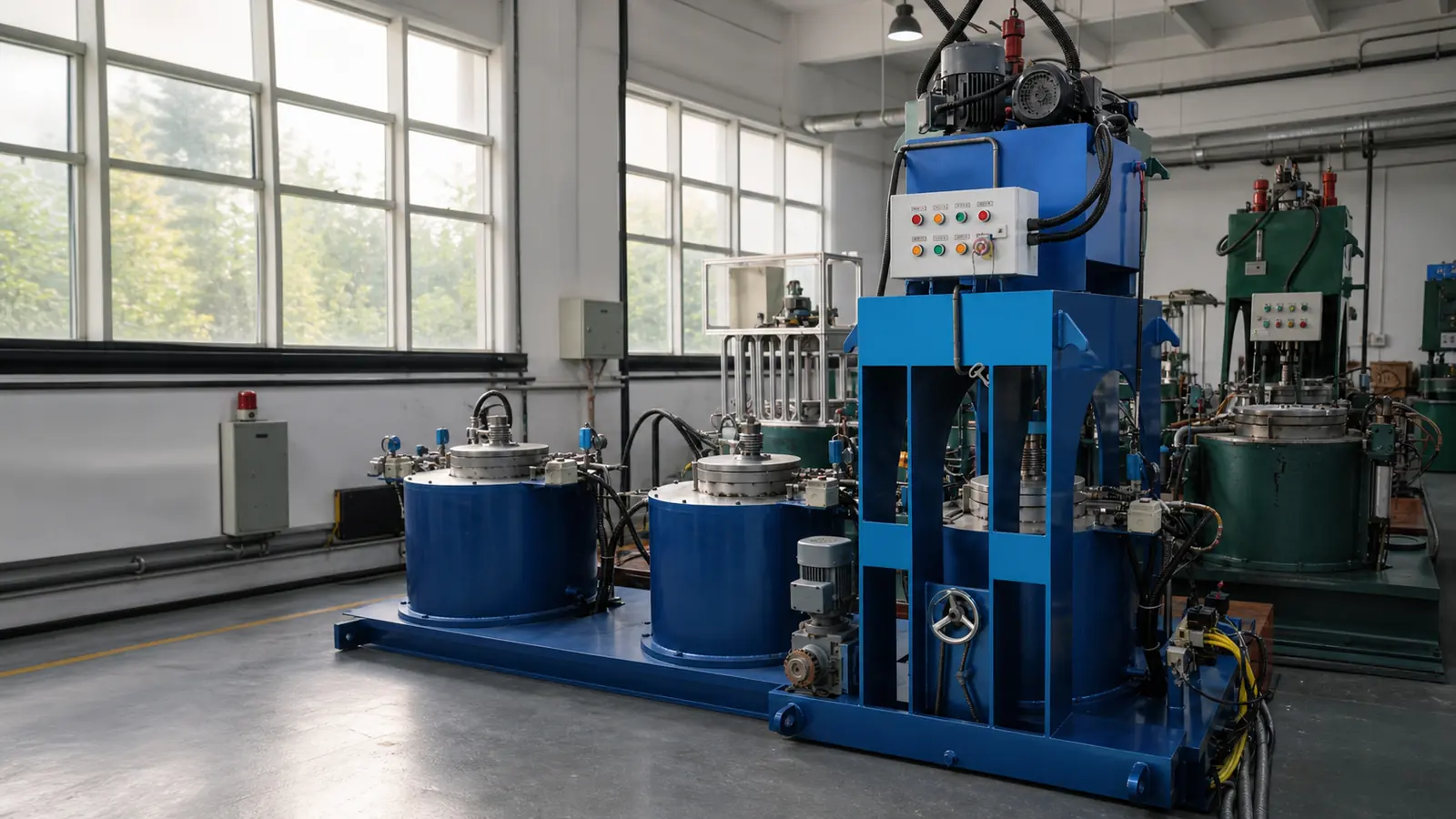
VMPE Vacuum Hot Press Furnace
For ceramic projects that require heat, axial force and vacuum as one controlled cycle.
- Graphite die, tooling and hot zone configured for the job.
- Recipe, force and displacement managed together.
- Traceable process data for qualification and transfer.
What to include in your enquiry
Provide the details that make it possible to review a pressure-sintering configuration against your actual ceramic and tooling plan.
- Material system, powder or preform condition and intended part geometry.
- Target density, porosity, dimensional and functional acceptance criteria.
- Die-stack drawing, expected working envelope and required force or travel.
- Thermal profile, vacuum or atmosphere target, trial quantity and production intent.
Technical references
- ISO 18754:2020 — Fine ceramics — Determination of density and apparent porosity.
- ISO 13383-1:2012 — Fine ceramics — Microstructural characterization — Part 1: Determination of grain size and size distribution.
- ISO 14704:2016 — Fine ceramics — Test method for flexural strength of monolithic ceramics at room temperature.