3D Printing Sintering Furnace: Thermal Processing for Additive Manufacturing Parts
A 3D printing sintering furnace is relevant to binder-based additive-manufacturing routes in which printing creates a green part that still contains binder. The furnace stage must remove or complete removal of that binder, then densify the powder structure without losing the required geometry or material condition.
Which AM routes need debinding and sintering?
The term “3D-printed metal part” covers different process families. NIST describes binder jetting as a route that deposits binder into a powder bed. That green body is not a finished dense metal component. By contrast, fusion-based routes consolidate material during printing and should not be placed automatically into a binder-removal workflow.
| AM route | Part state after printing | Debinding | Sintering | Selection implication |
|---|---|---|---|---|
| Metal binder jet | Powder body held by binder | Normally required | Normally required for densification | Confirm binder chemistry, green strength, shrinkage and support strategy. |
| Bound-metal material extrusion / Metal FFF | Metal-filled polymer feedstock shaped into a green part | Required according to the qualified feedstock route | Required after binder removal | Confirm whether solvent, catalytic or thermal debinding occurs before the furnace stage. |
| MIM-like printed feedstock | Binder-rich green part | Required | Required | Evaluate an integrated or separate debinding and sintering route. |
| Binder-based ceramic AM | Ceramic particles with an organic binder system | Required | Required, with material-specific atmosphere and support | Do not assume a metal hot zone or gas route is suitable for the ceramic composition. |
| Metal laser powder-bed fusion | Consolidated metal part | Not a binder-removal route | Not normally the same post-print sintering route | Evaluate stress relief, solution treatment, aging or HIP separately. |
| Polymer SLS | Polymer part | Use a polymer-specific thermal route | Not an industrial metal vacuum-sintering process | Select a polymer-specific post-processing route. |
From green part to final part
A binder-based route normally has four linked control stages. First, the green part must be handled and supported without damage. Second, binder removal must provide an escape path for decomposition products without creating internal pressure faster than the part can release it. Third, sintering must match the material system and densification target. Finally, controlled cooling must protect the required microstructure and geometry.
- Define the feedstock route. Record powder grade, binder supplier, binder fraction and the qualified debinding instructions.
- Plan gas removal. Consider section thickness, heating rate, load spacing, exhaust path and any required collection or filtration system.
- Match atmosphere and hot-zone materials. Vacuum, inert or reducing conditions must be compatible with the alloy, binder residue and furnace construction.
- Qualify shrinkage and support. Use representative parts or coupons to establish dimensional compensation, setter material and loading orientation.
- Define acceptance evidence. Density, dimensions, chemistry, surface condition and mechanical testing should follow the part requirement.
How to select the furnace route
An integrated debinding-and-sintering furnace can reduce transfers and handling, but only when its binder-management system, atmosphere control and hot-zone materials match the feedstock. A separate debinding stage may be more appropriate when binder removal creates a high contamination load or uses a solvent or catalytic process outside the sintering furnace.
Use the vacuum sintering furnace selection page to compare the available product families. For a purpose-built AM system, review the additive manufacturing sintering furnace configuration. Binder-rich feedstocks can also require the collection and process controls described on the MIM vacuum debinding and sintering furnace page.
Common failure modes and controlling inputs
| Observed problem | Inputs to review | Evidence to retain |
|---|---|---|
| Blistering or cracking | Binder-removal sequence, section thickness, heating rate, load spacing and exhaust capacity | Feedstock instructions, cycle record and sectioned samples |
| Residual carbon or surface contamination | Binder chemistry, atmosphere, gas flow, hot-zone condition and collection system | Chemistry result, chamber-cleaning record and blank cycle |
| Distortion or inconsistent shrinkage | Green density, part orientation, setter design, temperature distribution and packing density | Green/final dimensional map and load-temperature data |
| Density below target | Powder/feedstock condition, peak temperature, hold, atmosphere and initial packing | Density method, microstructure and qualified coupon record |
| Surface reaction or oxidation | Material grade, residual oxygen/moisture, hot-zone compatibility and gas purity | Gas certificate, vacuum trend and surface/chemistry inspection |
The related guide to MIM debinding and sintering defects provides a practical troubleshooting sequence for binder-related failures. For a broader product-to-process map, see powder metallurgy and MIM sintering applications.
Furnace sizing should follow the qualified feedstock route and actual load. The same nominal alloy can require a different cycle when binder chemistry, green density, part section or target properties change. Share these inputs before selecting an integrated debinding-and-sintering system, a dedicated sintering furnace or a separate debinding stage.
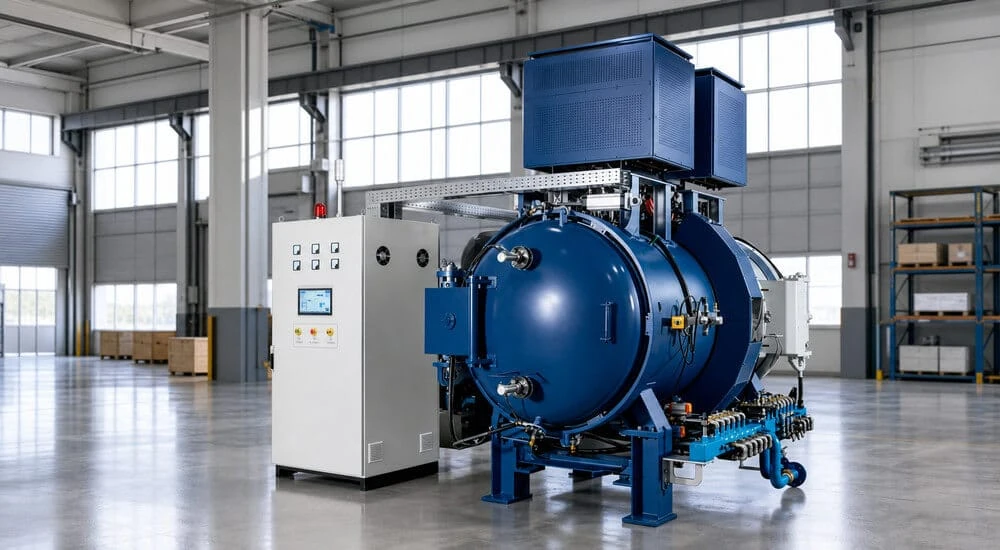
MIM Vacuum Debinding and Sintering Furnace
This route is appropriate when a binder-rich AM feedstock requires controlled binder removal followed by vacuum or controlled-atmosphere sintering; it is not the default for every 3D-printed part. For a purpose-built AM system, compare the additive manufacturing sintering furnace configuration. Final selection depends on the feedstock supplier’s process, contamination load, material and acceptance target.
- Binder-management and sintering stages reviewed as one process
- Load, atmosphere and hot-zone compatibility matched to the material
- Cycle records retained for qualification and repeatability
What to include in your enquiry
These inputs let the engineering team distinguish a real debinding-and-sintering project from a generic heat-treatment request:
- AM process, material grade and feedstock or binder system
- Supplier’s debinding method and any validated cycle limits
- Green-part dimensions, mass, section thickness and batch arrangement
- Expected shrinkage, target density and dimensional tolerance
- Peak temperature, atmosphere or vacuum requirement and support method
- Batch size, annual volume and acceptance criteria
Build the furnace specification around the feedstock
Send the AM process, material, binder system, green-part dimensions, target density, volume and acceptance criteria. SYNHTE can review the debinding route, atmosphere, hot-zone compatibility and loading requirements.
Send your project inputs