
SYNHTE engineering guide
Vacuum Furnace High Base Pressure: A Practical Troubleshooting Sequence
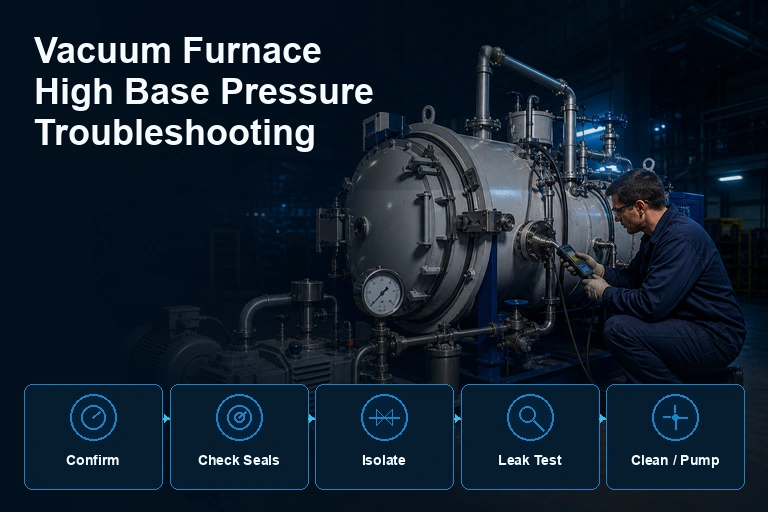
| Observation | First area to investigate | Useful evidence | Avoid |
|---|---|---|---|
| Poor pressure when empty and cold | Door seal, feedthroughs, valves, gauge and vacuum train | Pump-down curve and leak-up result | Adding longer process holds |
| Empty chamber is normal; loaded cycle is poor | Moisture, binder, porous fixtures and trapped volumes | Load and fixture change history | Opening the high-vacuum system first |
| Foreline behavior is abnormal | Backing pump, oil, filter, restriction or valve seating | Foreline pressure and service history | Replacing the high-vacuum pump without isolation tests |
| Gauge disagrees with process behavior | Sensor contamination, range or reference method | Comparison with an approved reference | Treating one reading as proof of a leak |
Vacuum furnace high base pressure: define the failure precisely
Before touching the furnace, compare the current cycle with a known-good baseline. Record:- Pump-down time to each pressure milestone.
- Lowest pressure achieved cold and after the normal clean/bake stage.
- Leak-up rate over a documented time interval.
- Foreline pressure, pump temperature and oil condition where applicable.
- Valve positions, load type, fixture type and whether the chamber was recently opened.
Step 1: rule out simple sealing and operating errors
Step 2: distinguish a real leak from outgassing or a virtual leak
A real leak admits gas from outside the system. Its signature often persists when the chamber is empty and clean. Outgassing comes from moisture, oil, binder, fingerprints, porous fixtures or a recently exposed hot zone; it normally improves with proper cleaning, drying and temperature under controlled conditions.A virtual leak is trapped gas released slowly from blind holes, overlapping plates, threads, enclosed channels or contaminated crevices. It can mimic an external leak even though the chamber boundary is intact. Review the new load, fixture and any changes to tooling before disassembling the furnace.Step 3: check the vacuum train in sections
Use the manufacturer’s diagnostic procedure to isolate the chamber, foreline, backing pump and high-vacuum section. Inspect pump oil, exhaust filters, traps, valve operation and the foreline for restrictions or contamination. A backing pump may run and sound normal while still failing to deliver the required pressure because of worn internals, contaminated oil, a blocked line or a valve that does not seat correctly.Confirm gauge health as well. Gauge contamination, wrong range selection or a damaged sensor can report a condition that does not match the actual system pressure. Compare only with approved reference methods.Step 4: correct the cause, then prove recovery
After repair or cleaning, repeat the same empty-furnace baseline test and document the result. Then run a controlled representative load before releasing production. If the process is qualification-sensitive, follow the customer’s deviation and requalification requirements.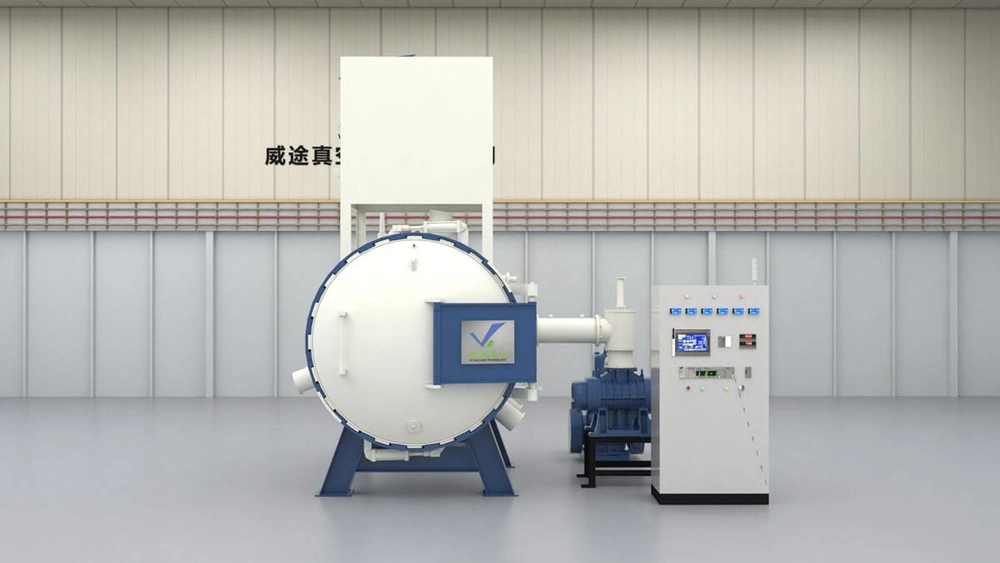
Recommended equipment
Vacuum Furnace Systems
Recurring pressure instability may be driven by the application, the load or the vacuum architecture. A system review should connect chamber volume, contamination load, pump train, instrumentation and cycle requirements instead of treating the pump as an isolated component.- Vacuum-train selection
- Pressure instrumentation
- Load and contamination management
Avoid these shortcuts
- Do not continue a brazing cycle solely because the pressure eventually reaches setpoint.
- Do not add longer holds to mask moisture, oil or binder contamination.
- Do not replace a pump before checking valves, seals, gauges and the actual load.
- Do not use a fixed “acceptable pressure” value across every alloy and process; the approved requirement depends on the process specification.
What to include in your enquiry
These details let the engineering team respond with a relevant configuration instead of a generic catalogue answer:- Pressure-versus-time trend from a normal and abnormal cycle
- Cold empty-chamber base pressure and documented leak-up result
- Foreline pressure, pump type and recent service history
- Load, fixture, cleaning and binder changes
- Alarm history and clear photos of seals or hot-zone contamination