
Low-Pressure Carburizing Process: Case-Depth Qualification
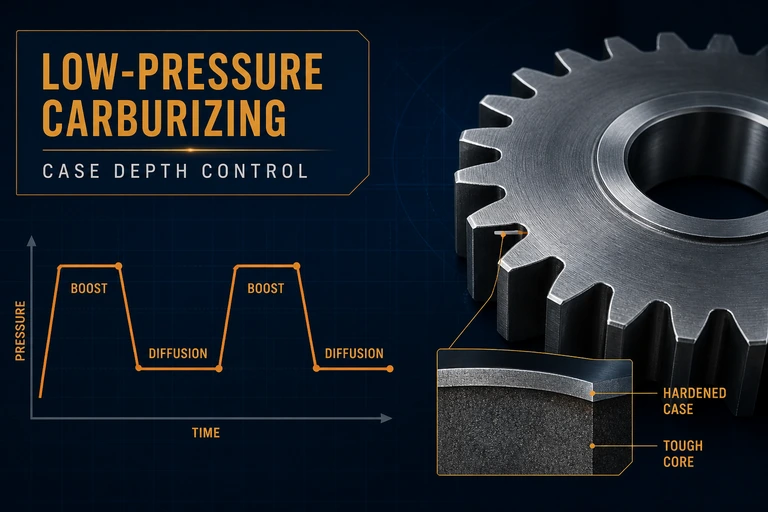
The low-pressure carburizing process is most reliable when it is treated as a qualification problem rather than a furnace-time problem. The required result is not simply a carbon-rich surface. It is a documented combination of effective case depth, hardness profile, core condition, dimensional response, surface condition and repeatability for a defined steel, part family and load pattern.
A good plan fixes the acceptance evidence before it fixes the boost and diffusion recipe. It also keeps the cooling route in the same decision: the carburizing cycle creates the carbon gradient, while gas or oil quenching helps determine whether the gradient becomes the intended hardened case without an unacceptable distortion result.
Start with the acceptance definition, not the cycle time
Begin with the part drawing, steel grade, target effective case depth, surface and core hardness requirements, allowable movement, batch envelope and annual output. These inputs prevent a technically plausible cycle from becoming a poor production decision. A deep case on a gear, for example, may be unacceptable if bore movement, tooth profile or local hardness variation exceeds the drawing limit.
Effective case depth must be tied to the customer or internal acceptance method. The qualification record should state the hardness threshold used for the traverse, sampling location, number of parts or coupons, metallographic preparation method when required, and the disposition rule for nonconforming samples. Without that definition, two teams can use the same words while judging different results.
ISO 18203:2026 is the current ISO reference for measuring the thickness of surface-hardened layers produced by treatments including carburizing and hardening. Use the purchased standard together with the drawing or customer specification to define the applicable depth term, test force, hardness limit, preparation and reporting method; do not carry an obsolete threshold into a new qualification without confirming that it is contractually required.
| Acceptance item | Why fix it early | Evidence |
|---|---|---|
| Effective case depth | It sets the carbon-transfer and diffusion objective. | Hardness traverse and specified depth criterion. |
| Hardness and core response | It links the result to steel condition and quench severity. | Surface, subsurface and core measurements. |
| Dimensional change | It determines fixture, spacing and cooling constraints. | Agreed critical-dimension inspection before and after treatment. |
Build the low-pressure carburizing process around boost, diffusion and load geometry
In low-pressure carburizing, programmed enrichment and diffusion stages are used to establish the surface-carbon condition and develop the required carbon gradient. The useful question is not whether a recipe contains a particular number of boost stages. It is whether the combination of temperature, gas dosing, pressure, stage timing and diffusion allowance is appropriate for the specified steel, required profile and actual load.
Part geometry and loading belong in the qualification plan. Blind holes, narrow slots, threaded passages and densely arranged parts can be treated effectively only when gas access, fixture contact, spacing and load density are reviewed alongside the recipe. A cycle that performs well on a sparse development load may not transfer unchanged to a tightly packed production basket.
The relevant vacuum heat-treatment furnace range should be considered as a process platform, not a generic chamber. For low-pressure carburizing, the process specification should identify the planned batch envelope, mass, load pattern, required pressure range, process-gas strategy and the data retained from each qualified cycle.
Temperature selection also needs an explicit metallurgy review. Higher carburizing temperatures can accelerate diffusion and may shorten a deep-case route when the steel and acceptance requirements permit, but they must be balanced against grain-control strategy, pre-existing material condition and dimensional limits. Treating temperature as a simple productivity lever can create a cycle that meets an early hardness reading yet causes unacceptable movement or a poor downstream response.
Treat quenching as part of the case-depth decision
Carburizing establishes a carbon profile, but the final hardness pattern and distortion response also depend on cooling. High-pressure gas quenching offers a clean, adjustable cooling route and is often evaluated where dimensional stability is important. A double-chamber oil-quench route can be more appropriate when the steel hardenability, section size, load mass or required cooling severity calls for it.
Do not choose the quench route from an isolated furnace-pressure preference. Review the steel grade, prior heat treatment, section thickness, tooth or bore geometry, fixture stiffness, permitted movement, throughput target and inspection result together. The same part family can require a different cooling route after a material or geometry change.
The Vacuum Carburizing Furnace platform is configured for repeatable low-pressure carburizing with gas-quench or double-chamber oil-quench cooling selected around the alloy, part geometry and production objective. The selection still needs a trial and acceptance record; no generic cooling route can guarantee a final part result.
Verify the result with a hardness traverse and controlled comparison
Qualification is stronger when the first approved cycle is compared with a defined baseline rather than judged from a single attractive micrograph. Record the furnace recipe, load map, fixture condition, pressure and temperature history, quench selection, measurement locations and inspection results. This makes it possible to distinguish a material-response change from a loading or equipment-control change.
For parts where surface integrity or metallurgical transition is critical, add metallographic examination according to the agreed method. The purpose is not paperwork around every batch. It is to prove that the carbon profile, hardened layer and core condition satisfy the acceptance decision and to establish a repeatable release method for production.
When a qualification result is marginal, change one relevant factor at a time: load spacing, fixture support, enrichment-diffusion balance, temperature window or cooling route. Simultaneous changes may shorten the troubleshooting loop but make the next result difficult to interpret. A controlled comparison protects process knowledge and the customer acceptance record.
Production release should retain the variables that actually control the result, not a generic furnace printout alone. Link the approved part and load map to the recipe revision, fixture arrangement, measured pressure and temperature history, cooling selection and inspection record. When an engineering change is proposed, this baseline identifies which acceptance checks must be repeated and helps prevent an unrelated production adjustment from quietly becoming a material or process change.
Review this record at the planned production cadence, especially after a steel-source change, fixture repair, material-condition deviation or major maintenance event. The goal is traceability that supports engineering decisions, not an extra inspection burden detached from the part-quality risk.
A low-pressure carburizing platform should be specified with the material, target case profile, allowable distortion, batch envelope, mass, annual throughput and preferred gas or oil quench route. SYNHTE can configure the furnace, cooling path and controls around those process inputs, while the final recipe and acceptance evidence remain specific to the parts being qualified.
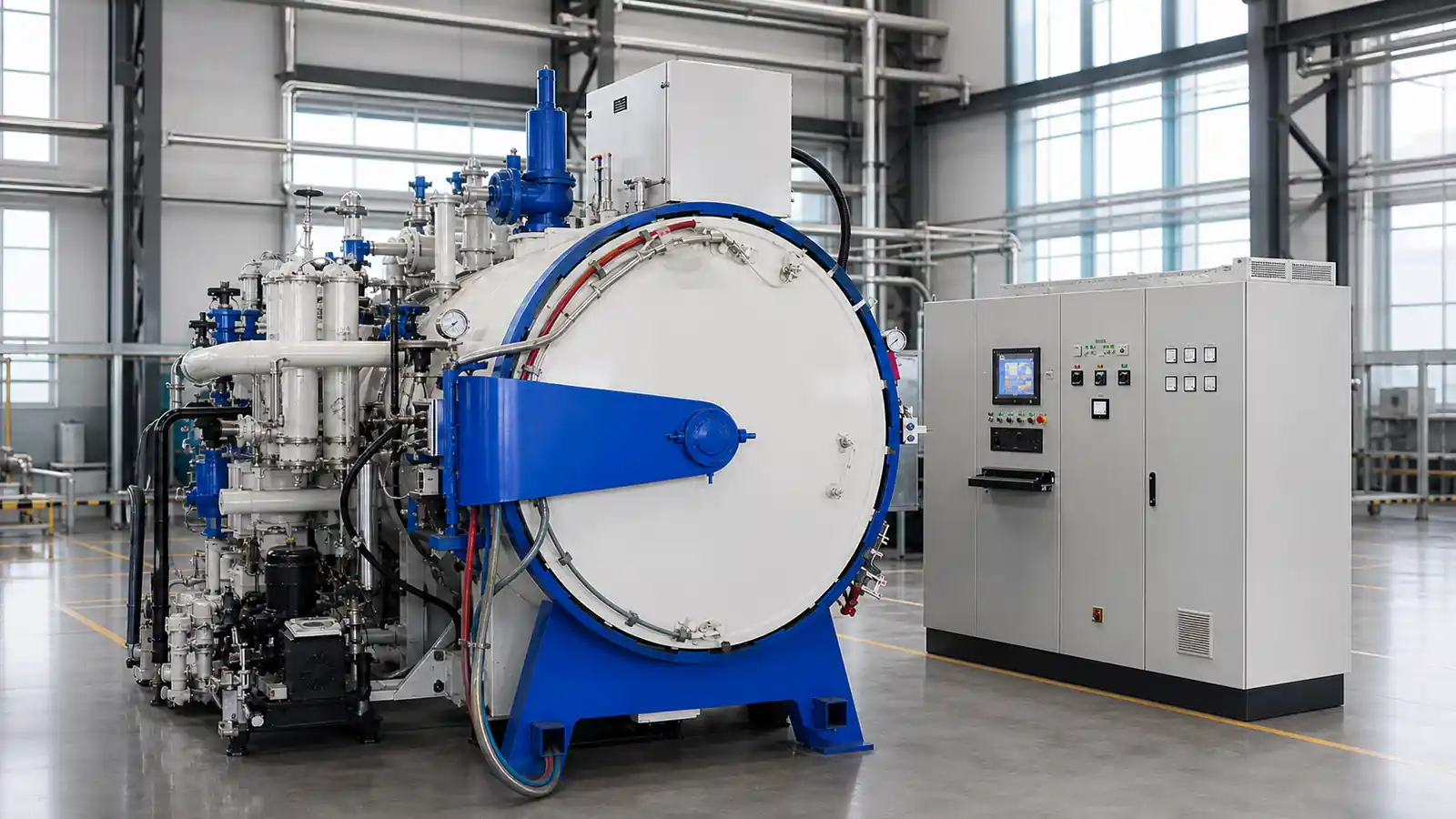
Vacuum Carburizing Furnace
For repeatable low-pressure carburizing with a cooling route selected around the part and process target.
- Programmed enrichment and diffusion for controlled case development.
- Gas-quench or oil-quench routes selected around steel and geometry.
- Recipe, vacuum, cooling and interlocks managed in one sequence.
What to include in your enquiry
Share the information that lets an engineering team review the case-hardening route against your acceptance requirements.
- Steel grade, part drawing and critical dimensions.
- Target effective case depth, hardness and inspection method.
- Batch envelope, mass, load pattern and annual throughput.
- Permitted distortion and the preferred gas- or oil-quench route.
Technical references
- ISO 18203:2026 — Steel — Determination of the thickness of surface-hardened layers. Apply the purchased standard together with the drawing or customer specification when defining and reporting case depth.