
Vacuum Gas Quenching: How to Choose Nitrogen or Argon for Your Parts
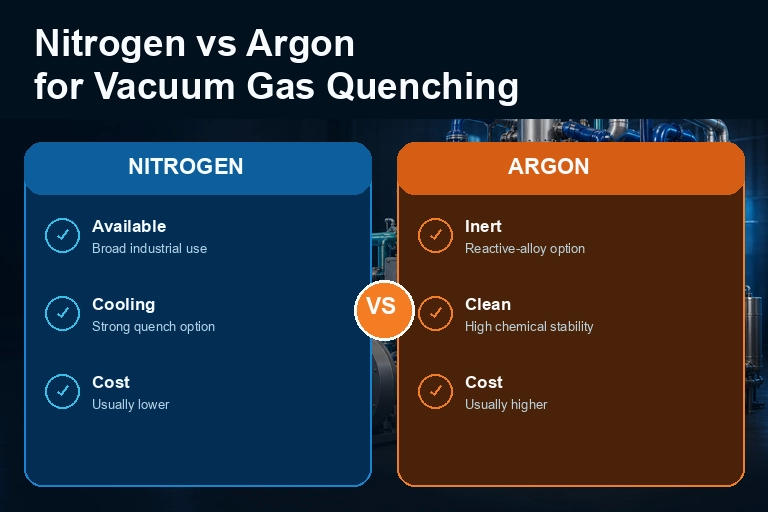
The question is not simply “nitrogen or argon?” The correct gas-quench choice depends on the required cooling curve for the alloy and section size, permitted surface reaction, fixture/load resistance to flow, available gas supply and total cost per qualified load. A gas that works for one tool-steel load may be unsuitable for a dense, complex or material-sensitive workload.
| Factor | Nitrogen | Argon | Decision question |
|---|---|---|---|
| Material compatibility | Suitable for many approved heat-treatment applications | Preferred when nitrogen reactivity is a concern | What does the alloy and process specification permit? |
| Cooling behavior | Generally stronger heat-transfer potential under comparable conditions | May require a different system approach to reach the target curve | What cooling curve and property result are required? |
| Operating cost | Usually more economical and widely available | Typically higher gas cost | What is the gas use per validated production cycle? |
| Validation | Must be proven on representative loads | Must also be proven on representative loads | What load represents the worst thermal case? |
Start vacuum gas quenching selection with the part requirement
Obtain the material specification, section thickness, target hardness or microstructure, distortion limit and approved heat-treatment recipe. The goal is to achieve the required cooling rate through the transformation range without over-quenching thin sections or creating unacceptable thermal gradients.
Gas pressure alone does not define cooling performance. The real result is created by gas type, pressure, blower capacity, nozzle/manifold geometry, heat-exchanger capacity, flow direction, load spacing and the thermal mass of the fixture.
Nitrogen: the practical default for many workloads
Nitrogen is widely available and often provides a cost-effective quench medium for alloys and cooling targets compatible with it. In a properly designed furnace, increased pressure and well-managed circulation can deliver repeatable cooling for many tool steels and general heat-treatment applications.
However, nitrogen is not chemically neutral for every material and process. Its suitability should be confirmed against the alloy specification, process temperature and customer requirements. Never assume that a more economical gas is an approved substitute.
Argon: when process compatibility is the priority
Argon is often selected where nitrogen interaction is a concern or where the customer’s process specification requires it. It is denser than nitrogen and can be useful in certain furnace and load configurations, but gas cost and circulation energy should be evaluated as part of the whole process—not in isolation.
For especially demanding cooling curves, some processes consider other gas choices or different quench methods. That decision requires metallurgical validation, safety review and equipment capability confirmation.
Five variables that commonly decide the outcome
- Alloy and hardenability: the material’s required cooling response sets the process window.
- Largest effective section: thick areas cool more slowly than thin features.
- Load and fixture openness: tightly packed parts or solid fixtures block flow.
- Gas-flow path: nozzle design, flow direction and return path affect local cooling.
- Heat-exchanger capacity: recirculated gas must reject heat reliably through the full cycle.
Validate with a representative load
Use an approved trial plan that reflects the production load, not only a convenient small sample. Record furnace pressure, gas type, blower behavior, cooling curve, hardness/microstructure results and distortion. If a load layout changes, re-check the result rather than relying on previous qualification data.
Gas selection belongs inside the wider heat-treatment route. The vacuum heat treatment furnace range covers processes where inert-gas cooling is one part of the cycle. A vacuum carburizing furnace adds case-depth and quench-route requirements, while a vacuum oil quenching furnace represents a different cooling method when gas cooling cannot achieve the qualified result. These routes are alternatives to evaluate, not interchangeable gas choices.
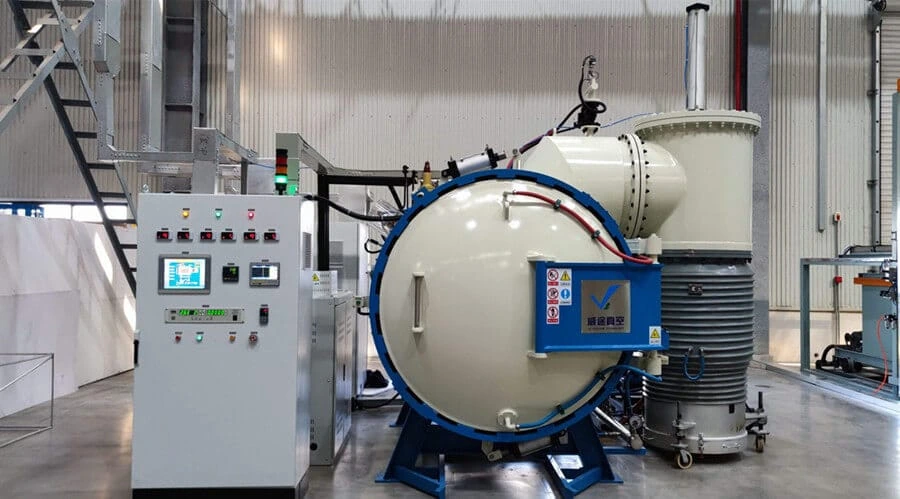
Vacuum Gas Quenching Furnace
Gas selection cannot be separated from furnace design. Review blower capacity, heat-exchanger performance, gas direction, pressure level, work-zone dimensions and load obstruction together with the alloy and target cooling curve.
- Gas circulation and pressure
- Heat-exchanger performance
- Representative-load validation
Specify the furnace around the process window
When requesting a gas-quenching furnace, provide the material grade, maximum part section, load mass, required cooling curve, work-zone size, target cycle time, quench-gas preference and utility availability. A meaningful proposal can then address blower arrangement, gas pressure, heat exchanger, nozzle configuration, controls and safety systems.
For help translating your part requirement into an equipment specification, contact SYNHTE. Include a drawing, material specification, heat-treatment requirement and the current quality issue if there is one.
What to include in your enquiry
These details let the engineering team respond with a relevant configuration instead of a generic catalogue answer:
- Alloy grades and applicable process specification
- Part dimensions, section thickness and maximum load mass
- Target hardness, microstructure or cooling curve
- Preferred or prohibited quench gases
- Production rate, installation utilities and gas supply conditions
Compare quench options for your actual load
Share the alloy, maximum section, load mass, required cooling result, cycle-time target and available gas supply. Ask SYNHTE to review your gas-quenching application.