Low-Pressure Carburizing Recipe Qualification: Boost–Diffuse Control and Case Profile

Low-pressure carburizing recipe qualification should treat the boost–diffuse recipe as a controlled carbon-transfer sequence, not as a fixed pressure-and-time formula. Define the steel, incoming condition, geometry, effective case-depth and hardness criteria, then develop boost exposure, diffusion time, temperature, gas delivery, load arrangement and quench route together. Release the recipe only when position-based case profiles, hardness, microstructure, dimensional results and repeat-cycle evidence demonstrate that the real production load meets its requirements.
Define the required case profile before adjusting the recipe
Start with the drawing, material specification and acceptance plan. Record the steel grade, incoming microstructure, prior processing, surface condition, critical geometry, required effective case depth, surface and core hardness, microstructure limits, distortion limits and test method. The target is not simply “more carbon.” It is an accepted depth and property profile at named locations, achieved without unacceptable carbides, retained austenite, oxidation, soot, surface damage or dimensional movement. Requirements vary by alloy and application, so the governing drawing and standard must control the definition.
Separate nominal case depth from the acceptance method. Effective case depth depends on the hardness criterion and measurement procedure in the governing requirement. A metallographic profile, microhardness traverse, surface carbon measurement and core-hardness result answer different questions. Define sectioning direction, edge preparation, spacing, reporting units and the locations that represent thin teeth, roots, blind holes, heavy sections and shielded surfaces. A coupon beside the load is useful only when its material, geometry, thermal history and carbon access represent the feature being released.
Translate the part requirement into a recipe-development boundary. Identify fixed variables, adjustable variables and response variables. Furnace temperature, carburizing gas identity, gas-delivery logic, boost duration, diffusion duration, number of pulses, pressure-control method, load arrangement and quench route can all influence the result, but they cannot be changed freely during production. Establish which variables belong to the approved recipe and which require engineering change control.
Define the initial production load before recipe trials begin. Part count, total mass, surface area, fixture design, basket position, spacing, hole orientation and the relationship between dense and open regions affect gas access and thermal response. A light development load may establish a safe starting point, but it does not prove the recipe for a dense production batch. Use deliberately selected witness positions so the qualification can identify both high and low carbon-transfer conditions.
Understand what boost and diffusion segments are controlling
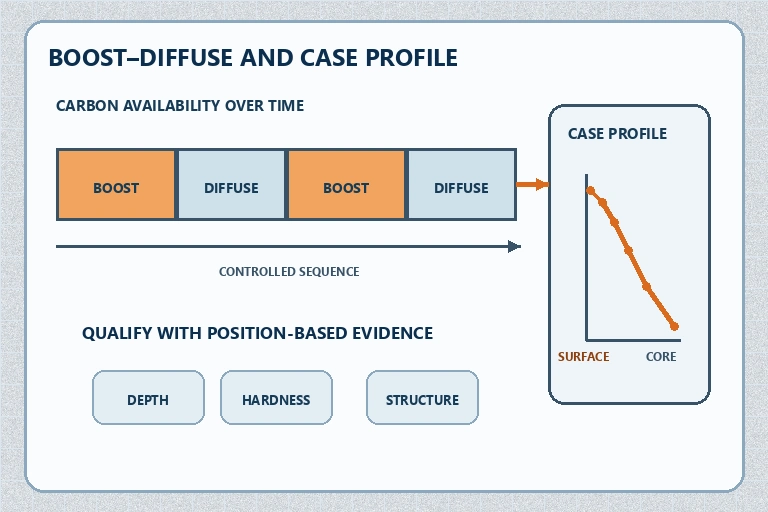
During a boost segment, the furnace introduces the carburizing species under the qualified temperature and pressure-control strategy so carbon becomes available at the workpiece surface. During the following diffusion segment, the gas addition is reduced or stopped according to the recipe while carbon redistributes from the surface toward the interior. Repeating these segments can build the required profile while controlling surface saturation, but the result depends on the steel, temperature, geometry and previous pulses. The words boost and diffusion describe functions; they do not define a universal duration, pressure or gas quantity.
The useful engineering question is how each pulse changes the boundary condition at the surface and the gradient below it. Early pulses may build surface carbon rapidly, while later diffusion time allows redistribution toward the specified depth. Excessive carbon availability can increase the risk of surface saturation, soot or carbide-related problems for some alloys and conditions. Insufficient availability or excessive diffusion can leave the case shallow or reduce the surface result. The balance must be demonstrated with the actual material and acceptance evidence rather than inferred from gas-flow command alone.
Pressure is a process variable, not a carbon-profile measurement. The same nominal pressure can represent different delivered gas quantities, residence conditions or surface reactions when chamber volume, load surface area, pumping state, control logic or injector condition changes. Record the commanded and actual signals that matter to the installed system, then compare them with the part evidence. If the equipment uses pulsed delivery, document valve timing, stabilization logic and the method used to confirm repeatability.
Temperature history remains inseparable from carbon transfer. Heating uniformity, load lag, thermocouple location and the timing used to start the first boost can shift the effective exposure. A recipe that begins pulsing when a furnace sensor reaches setpoint may behave differently from one whose qualification confirms the production load has reached the defined condition. Preserve the qualified trigger logic and the sensor identities used to support it.
Build a development matrix around material, load and response
Use a controlled development matrix instead of changing several variables after each result. Lock the steel heat or documented material condition, specimen geometry, fixture, load pattern, furnace configuration, heating sequence and quench route for a planned series. Select only the variables needed to answer the current question, such as pulse count, boost-to-diffusion balance or total exposure. Keep a record of the starting hypothesis, the change made and the evidence expected to move.
| Control group | Evidence to retain | Decision protected |
|---|---|---|
| Material and geometry | Steel identity, incoming condition, surface state, controlling section and feature locations | Prevents a material or geometry change from being mistaken for a recipe effect |
| Load and furnace | Part count, fixture, position map, total mass, usable work zone and furnace identity | Connects gas access and thermal response to the real batch |
| Recipe execution | Temperature record, pulse sequence, pressure and gas-delivery signals, alarms and deviations | Shows whether the intended boost–diffuse sequence actually ran |
| Product response | Position-based hardness profile, case depth, microstructure, surface condition and dimensions | Ties process settings to the acceptance outcome |
Choose trial positions that can reveal within-load variation. Include locations with restricted gas access, different section sizes, high fixture shadowing or critical distortion risk when they exist. Do not average away a failing position. The point of the development matrix is to define a recipe and load envelope that protects the least-favorable required feature, not to produce an attractive mean result.
Use replication before declaring a trend. One successful cycle can identify a promising setting, but repeated loads are needed to evaluate furnace repeatability, setup variation and measurement scatter. Record the same sensor channels, timing definitions and sampling locations across trials. If a test method or laboratory changes during development, bridge the old and new method before joining the data sets.
Keep quenching inside the matrix. Case formation and final hardness are connected but not identical. An acceptable carbon profile can still produce an unacceptable hardness, microstructure or distortion result if the selected gas or oil quench does not match alloy hardenability, section size, load density and fixture resistance. Separate the evidence for carbon profile, transformation and dimensions, then require all three to meet the project plan.
Low-pressure carburizing recipe qualification across the production load
Move from development to qualification only after the proposed recipe and load definition are frozen. The qualification plan should name the furnace, hot-zone condition, gas supply and quality controls, delivery system, recipe revision, fixture, part count, load mass, load map, sensor locations, quench route and acceptance sampling. Capture deviations in real time. A cycle that passes after an undocumented operator adjustment is not evidence for the frozen recipe.
Evaluate both local and load-wide results. Map effective case depth, surface and core hardness, microstructure and dimensions to the part and furnace positions defined in the plan. Where the governing requirement calls for other evidence, include it without substituting a convenient measurement. A surface hardness result cannot establish the complete case profile, and a single metallographic section cannot establish uniformity across a complex batch.
Confirm that the selected quench is part of the demonstrated route. High-pressure gas quenching can support clean handling and controlled cooling for suitable alloys and sections, while an oil-quench route can provide different cooling severity for defined applications. The correct choice depends on hardenability, geometry, load density, distortion limit, surface requirement and production duty. Do not use this article as a universal gas-versus-oil selection rule; use the alloy data, qualification plan and installed equipment capability.
Establish the approved production window and response plan. State allowable setup variation, load range, fixture condition, recipe revision, gas controls, sensor status and any defined reaction to alarms or incomplete pulses. Define who can release a cycle with a deviation and what additional testing is required. Retain enough raw process data to distinguish an execution failure from a product-test anomaly.
Complete a capability review after the repeat qualification loads. The purpose is not to force statistical conclusions from a small sample, but to show that the recipe is centered with defensible margin against the acceptance boundaries. If results cluster near a limit, treat that as a development concern rather than relying on final inspection to sort production indefinitely.
Control recipe transfer, maintenance and material changes
A recipe file is not portable evidence by itself. Before transfer to another furnace, compare chamber and work-zone geometry, hot-zone material and condition, heating response, gas-delivery hardware, pumping behavior, pressure-control method, sensor locations, fixture arrangement, quench system and control-software logic. Even when two furnaces display the same temperature, pressure and segment time, the production load may experience a different carbon-transfer and cooling history.
Use a documented equivalence assessment to decide how much requalification is required. A transfer between demonstrably matched systems may support a reduced plan, while a different chamber, injector arrangement, hot zone, gas route, quench system or load envelope can require broader development. Preserve the original recipe identity and create a controlled destination revision rather than overwriting the source file.
Apply the same discipline after maintenance. Gas-valve replacement, flow-control work, pressure-sensor change, pumping-system repair, hot-zone replacement, thermocouple relocation, fixture modification and quench-system service can change the relationship that the recipe qualification established. Define verification from risk and evidence. A completed work order does not prove that boost delivery, diffusion behavior or final part response remained equivalent.
Material and upstream changes can also move the result. A new steel heat, altered incoming microstructure, different machining allowance, surface residue, changed cleaning route or revised geometry may change carbon response or the acceptance measurement. Link incoming material identity and process revision to every released load so a trend can be investigated without guessing which condition changed.
Keep configuration backups, access control and recipe audit trails appropriate to the quality system. Restrict uncontrolled edits, record who approved a revision and require a first-off or defined verification load when the change plan calls for it. The durable production asset is the connected set of recipe, load definition, furnace configuration and qualification evidence—not the controller file alone.
Match the furnace configuration to the boost–diffuse and acceptance plan
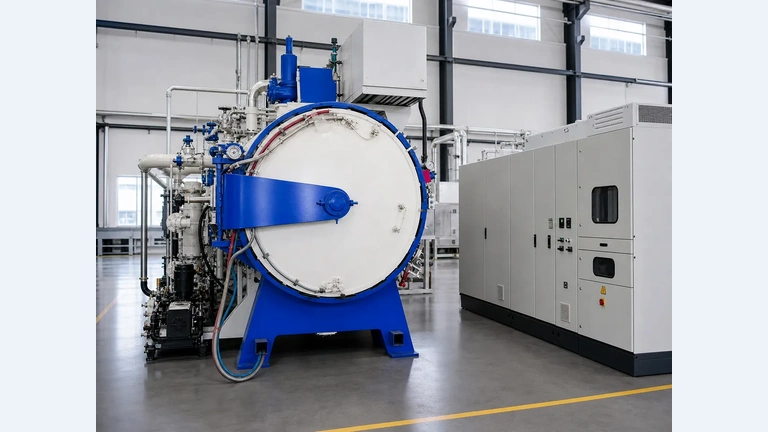
SYNHTE's Vacuum Heat Treatment Furnaces are selected from the alloy, target properties, load, cooling method and production duty. For a carburizing project, the current Vacuum Carburizing Furnace page asks for the effective case-depth and hardness criteria, workload geometry, fixture, batch mass, distortion limit, production rate and gas- or oil-quench route. Those inputs should be defined before a recipe-development schedule is treated as a furnace specification.
Review the gas-delivery, temperature-control, pressure-measurement, data-recording and quench requirements as one system. State which boost and diffusion signals must be recorded, how the production load reaches the start condition, how recipe revisions are protected, and how the selected quench is qualified. If blind holes, splines, heavy gears or mixed-section loads are critical, identify their orientation and representative test locations in the request for quotation.
For an engineering review, provide the steel grade and incoming condition, part drawings, critical case-depth locations, hardness and microstructure criteria, batch map, fixture, annual or shift volume, current recipe knowledge, preferred cooling route, distortion limits, utilities and required records. This lets the equipment and qualification discussion begin from the real product decision instead of from a copied nominal cycle.
Vacuum Carburizing Furnace
SYNHTE configures vacuum carburizing systems around the alloy, effective case-depth target, workload, distortion limit, production rate and selected gas- or oil-quench route. Recipe development must therefore be tied to the specified chamber, gas delivery, heating, control, loading and cooling configuration rather than transferred as an isolated time-pressure table.
What to include in your enquiry
- Exact material, incoming condition and governing drawing or specification
- Part, interface, fixture, stack and production-load drawings
- Required process outcome, acceptance methods, limits and sample locations
- Current process route, fixed variables, development questions and known risks
- Batch volume, data-retention needs, utilities, site interfaces and delivery requirements