
PDC Drill Bit Assembly: Matrix Infiltration Is Not Cutter Brazing
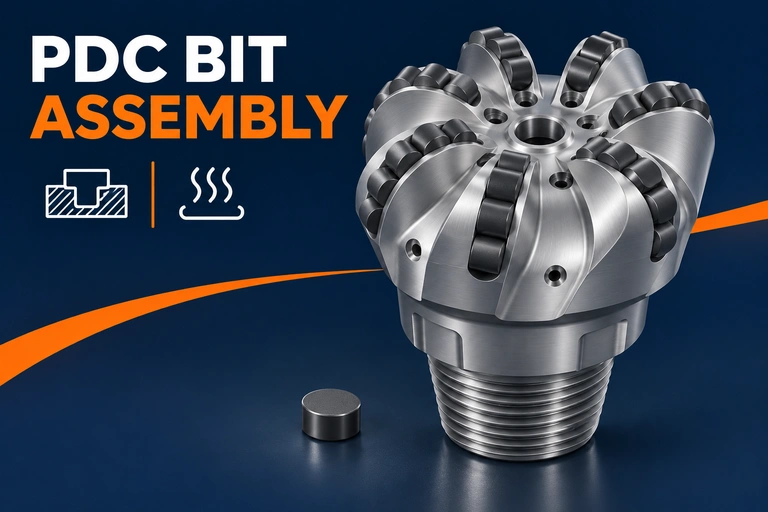
PDC drill bit assembly is not one manufacturing step. A polycrystalline diamond compact (PDC) cutter contains a diamond cutting layer bonded to a supporting substrate, while the drill body provides pockets that locate and support those cutters. Producing the body and attaching the cutters are separate questions. A matrix-body description does not, by itself, mean that conventional PDC cutters were incorporated during body infiltration or that no subsequent brazing operation is needed.
This distinction matters when requesting a furnace, investigating lost cutters or transferring work between suppliers. Identify the interface being made before selecting a temperature, filler or acceptance test. Otherwise a body-forming operation can be mistaken for a cutter-joining process, with a thermal history that the completed cutter was never approved to receive.
Separate three interfaces before discussing the process
The term “diamond bit” can conceal very different material systems. Start by separating the diamond layer within a PDC cutter, the composite within a matrix body and the joint that secures a cutter to its pocket. These interfaces do not have the same manufacturing purpose, and evidence for one does not qualify the other two.
| Interface | What it establishes | Evidence to identify |
|---|---|---|
| Diamond table to cutter substrate | The supplied cutting element, not its attachment to the drill body. | Cutter grade, geometry, incoming condition and supplier restrictions. |
| Carbide particles to metallic binder in a matrix body | The body composite and the supporting blade structure. | Body manufacturing route, material identity and finished pocket condition. |
| Cutter substrate to body pocket | The assembly joint that retains and supports the cutter. | Joint drawing, filler system, thermal procedure and retention acceptance. |
Keep those records distinct in a purchasing specification. A certificate for the matrix material cannot establish that a cutter was brazed correctly. Equally, a satisfactory external braze fillet cannot prove the integrity of the diamond-to-substrate interface. State which organization supplies each component and which operation the furnace project actually covers.
Identify the body route without assuming the cutter route
Steel bodies and carbide-rich matrix bodies provide different starting points for assembly. A steel body can provide machined blade and pocket features. A matrix route can form a carbide-rich composite using an infiltrating metallic binder. Neither description is a complete cutter-attachment specification. A body delivered with empty cutter pockets still requires the specified assembly operation.
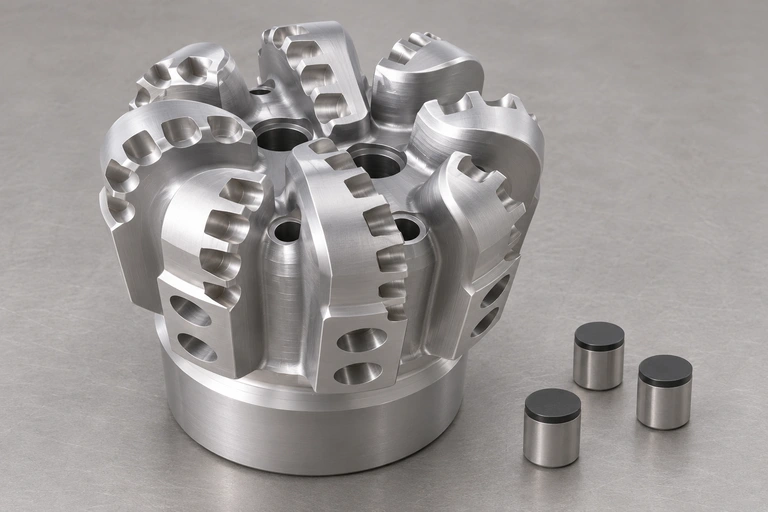
Smith International's published matrix-body disclosure describes an infiltrated body and cutters subsequently brazed into its pockets. This is a documented counterexample to the blanket claim that a matrix body eliminates cutter brazing. It does not establish that every manufacturer uses that exact route. Alternative retention or specialized cutting-element designs must be checked against their own drawings and process documents.
Ask the body supplier what is already present: finished pockets, coatings, hardfacing, gauge inserts, nozzles and any previously joined components. Identify whether a proposed heating operation exposes only a local joint or the complete body. Avoid inferring composition, internal construction or allowable temperature from a silver-colored surface or a photograph of a finished bit.
Locate the joint in the cutter's support geometry
For a conventional pocket-brazed cutter, the joining interface lies between the cutter substrate and the supporting pocket. The diamond face is the cutting surface, not an area to cover indiscriminately with braze. The pocket drawing establishes engagement and position; the joining procedure establishes how the specified filler occupies the intended interface.
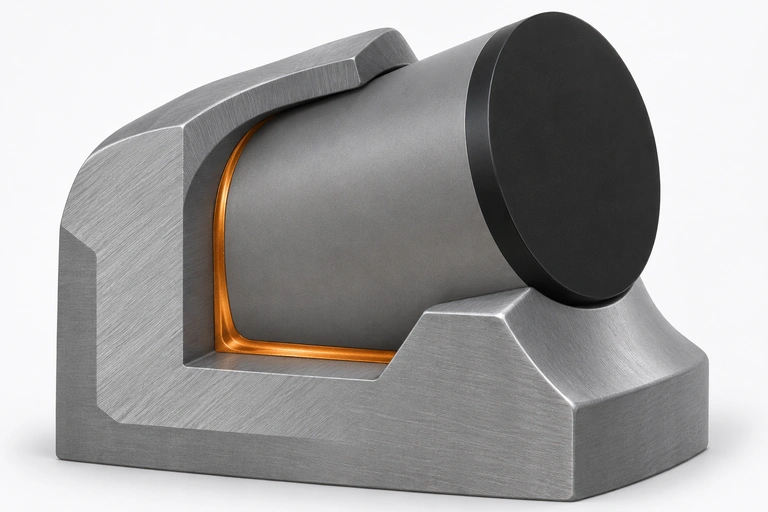
Review support depth, cutter orientation, access for filler placement and the surfaces that remain exposed after assembly. Do not substitute one nominal gap for the complete geometry. A pocket may constrain movement differently around its circumference, and the hot assembly can differ from the cold fit. The joint review should follow the actual body, substrate and filler combination.
When a cutter is lost, preserve the failed pocket and recovered cutter if available. Distinguish separation within the joint from cutter fracture, substrate damage or loss of supporting body material. These observations lead to different investigations. Treat a retention test as evidence for its defined loading arrangement, not automatic proof of drilling life under every combination of impact, vibration and erosion.
Assign thermal limits to the actual components
PDC is a family of cutting-element designs rather than one invariant thermal rating. SLB's cutter portfolio includes different geometries and application-specific technologies. Obtain processing restrictions for the exact supplied cutter, including its material condition and any relevant treatment. A temperature associated with a different cutter or test atmosphere is not a production limit for the assembly in hand.
The cutter-brazing patent discusses thermal damage to the diamond table and the role of the carbide substrate in the assembly. Its particular filler arrangements are patented examples, not a recommendation to copy a multi-alloy joint. The engineering lesson is to consider where the cutter experiences heat and how much exposure the approved assembly can tolerate.
A matrix-body infiltration cycle therefore must not be assigned to a completed cutter merely because both operations involve a furnace. Similarly, a furnace's rated maximum does not define the useful brazing window. Determine whether the proposed equipment can control the required lower operating range, heating distribution and cooling behavior with the real body and fixture.
Include earlier operations and intended repair cycles in the history. Hardfacing, body heat treatment, previous cutter replacement and subsequent joining can affect the condition being qualified. This is particularly important when a supplier receives a partly finished body without its earlier records. Missing history should remain an explicit engineering question rather than being replaced by an assumed “standard PDC cycle.”
Write a handoff that identifies the unfinished operation
Define the incoming assembly state in plain terms: body without cutters, body with temporary cutter positioning, completed new assembly or used body submitted for repair assessment. Identify the drawing revision, body material, pocket condition, cutter specification and filler identity. Record what is fixed and what still needs development before the work is priced as repeat production.
For development, link the question to an observable result. A pocket-fit trial addresses assembly geometry; a representative thermal trial addresses exposure; sectioning or a defined mechanical test addresses a particular interface. The approved plan must establish methods and acceptance criteria. Combining several trials may be necessary, but their results should not be collapsed into one unexplained statement that the bit “passed brazing.”
Repair needs its own disposition. Removing a damaged cutter, preparing the pocket and reheating the body are not automatically covered by a new-build procedure. Check remaining support material and the permitted cumulative exposure before choosing replacement components. Do not compensate for an unidentified retention failure simply by adding filler or increasing temperature.
Specify the operation before selecting the furnace
Compare vacuum brazing furnace systems only after the intended joint and atmosphere route are established. Vacuum processing is a candidate for an approved cutter-to-pocket system; it is not a consequence of the PDC label. A body-infiltration requirement and a cutter-brazing requirement should be stated separately even if the same organization performs both.
If a batch vacuum-brazing route is justified, the High-Temperature Vacuum Brazing Furnace is a platform to discuss against the actual application inputs. Review the useful control range, loaded envelope, hot-zone compatibility, vacuum architecture, measurement access and cooling route. The product family does not itself qualify a particular PDC cutter or imply that the cutter should approach the platform's maximum temperature.
The practical starting point is an interface map and a clear incoming-state record. With those in place, the furnace discussion can address the unfinished joining operation rather than mixing cutter manufacture, body formation and final bit assembly into one unsupported recipe.
High-Temperature Vacuum Brazing Furnace
Discuss the actual cutter-to-pocket operation, not only the drill-bit label. For a qualified batch vacuum-brazing route, review the useful operating range, load response, hot-zone compatibility, sensor access and cooling requirements. A furnace maximum temperature is not a PDC cutter processing recommendation.
Prepare the engineering evidence
Provide the body construction and condition, cutter grade and supplier thermal restrictions, pocket drawing, filler identification, previous thermal history, proposed load and the acceptance method for cutter retention.
Technical references
- Smith International: matrix-body fixed-cutter bit disclosure — Describes matrix infiltration and subsequent cutter brazing as separate operations; an example route, not a universal production specification.
- Smith International: PDC cutter brazing disclosure — Distinguishes the diamond table, carbide substrate and cutter-pocket attachment, and discusses thermal damage concerns; patented embodiments are not adopted as a shop recipe.
- SLB: application-specific PDC cutter families — Shows why cutter design and grade must be identified rather than treating all PDC cutters as interchangeable.