Meet SYNHTE at HK 2026 in Cologne | Booth E-043
SYNHTE will exhibit at HK 2026 HeatTreatmentCongress in Cologne, Germany, from October 13 to 15, 2026. Visit us in Hall 10.2 at Booth E-043 to discuss custom vacuum heat treatment solutions for your parts, process and production goals.
Our exhibition message, “Engineer for Your Process,” puts your application at the centre of the conversation. We welcome manufacturers, heat treatment specialists, engineering teams and partners who are developing a new process, expanding capacity or reviewing their next furnace investment.
Meet us at HK 2026: dates, venue and booth
The 2026 event brings together the HeatTreatmentCongress, the IFHTSE World Congress, the European Conference on Heat Treatment and Steel Innovation. With an international exhibition alongside the congress programme, it offers a meeting point for equipment suppliers, manufacturing teams and researchers working across thermal processing and materials technology.
- Event: HK 2026 HeatTreatmentCongress
- Dates: October 13–15, 2026
- Venue: Koelnmesse, Cologne, Germany
- Hall and booth: Hall 10.2, E-043
- Exhibition hours: October 13–14, 09:00–18:00; October 15, 09:00–16:00, local time in Cologne
You can find our team under Henan Synthe Corporation in the official exhibitor directory. Use the organiser’s exhibition information to check opening times and visitor arrangements before travelling. For a project discussion, send us your preferred day and time together with a short application summary so that the meeting can focus on the questions most relevant to your team.
Engineer for your process, from part to production load
A useful furnace discussion starts with the result you need from the finished component. Alloy grade, incoming material condition, part geometry and the required hardness, microstructure or surface condition help define the processing route. These details are especially valuable when a new product combines a larger critical section, a tighter distortion limit or a different material from an established production family.
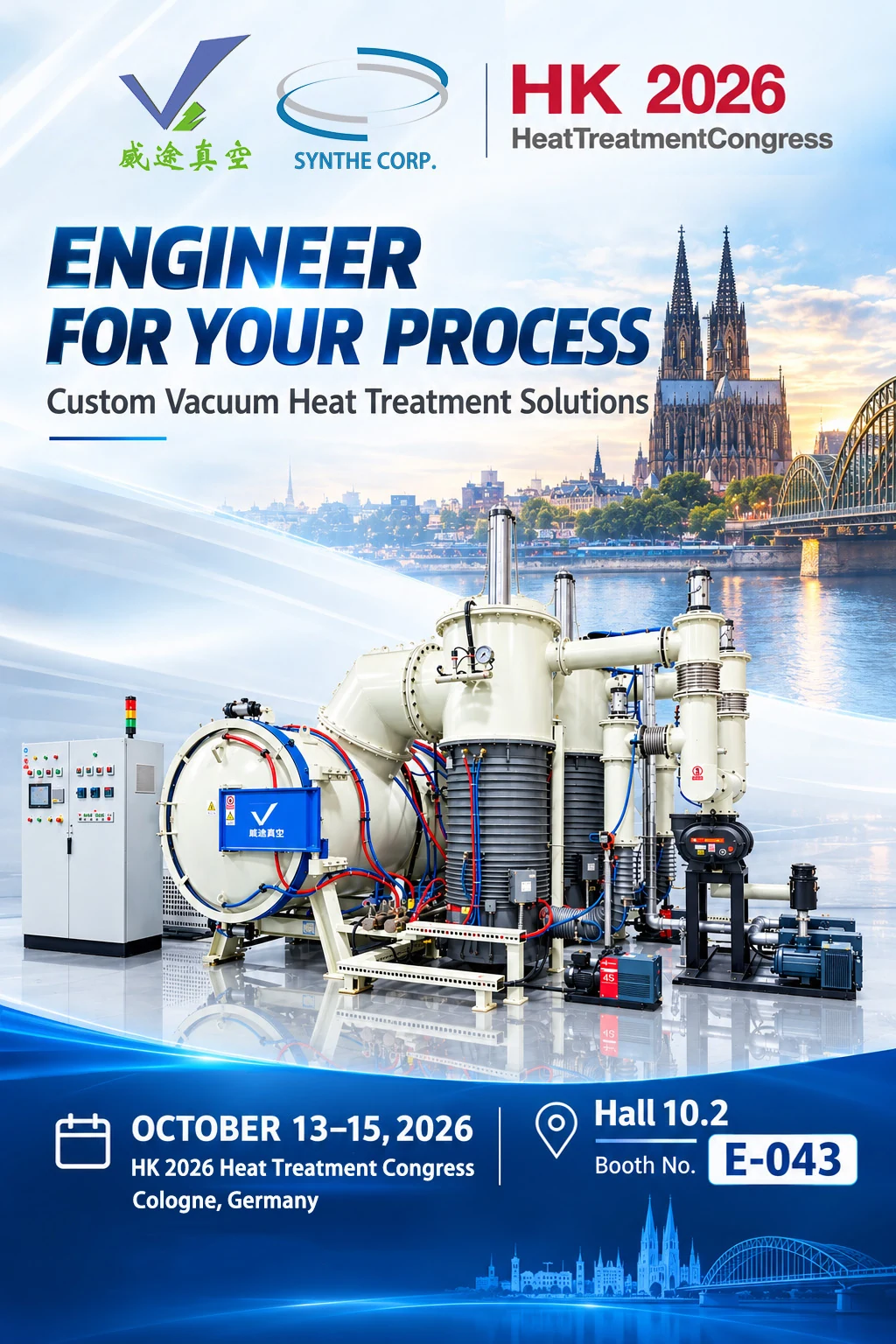
Our HK 2026 invitation presents a complete vacuum furnace assembly, with the chamber, control cabinet and connected pumping hardware visible together. The arrangement highlights an important part of custom equipment planning: the furnace is a system of interacting components. Loading access, installation space, service access and utilities belong in the same discussion as the thermal process.
Next, describe the complete production load. The largest part is only one input: fixtures, supports, spacing and batch mass also determine the usable work zone and the heating and cooling task. At the booth, a drawing or loading sketch can help us connect the component envelope with a practical chamber size and handling concept. This makes the discussion more useful than comparing maximum temperature or nominal capacity alone.
Discuss the heat treatment route that fits your components
Our vacuum heat treatment furnace range covers different production needs, including gas quenching, oil quenching, carburizing, annealing and tempering. We invite visitors to discuss the complete route around their component, including heating, cooling, handling and subsequent operations. The aim is to identify which equipment family should be evaluated against the actual material and manufacturing requirement.
For alloys and sections suited to gas cooling, the Vacuum Gas Quenching Furnace combines vacuum heating with a configured gas-quench system. Gas identity, circulation, pressure and heat-exchanger capacity should be reviewed together with the load. Bring the critical section, batch density and target properties so the cooling discussion can address the part response as well as the equipment settings.
Where the material and section require an oil-quenching route, the Vacuum Oil Quenching Furnace provides a different equipment architecture. Transfer between heating and quenching, oil handling, washing and tempering can all affect the production plan. Comparing gas and oil routes at the application level helps establish which interfaces and acceptance checks need to be included in a proposal.
For bright annealing, magnetic annealing or stress relief of compatible materials, explore the Vacuum Annealing Furnace. Here, the discussion may centre on temperature uniformity, surface condition, load presentation and the cooling profile. If your project involves case hardening, tell us the intended case-depth and core-property requirements so that the carburizing and quenching stages can be considered together.
Connect hot-zone design with your material requirements
The furnace interior deserves as much attention as the external equipment layout. The graphite hot-zone photograph below shows the chamber’s internal heating arrangement and the space that must accommodate the workload. Reviewing this physical arrangement helps explain why part size, fixture geometry and access requirements need to be considered together when discussing a furnace configuration.

Graphite and metallic hot zones serve different application requirements. Selection follows the process temperature, alloy sensitivity, cleanliness expectations and maintenance priorities. Tell us about surfaces that require particular attention, any restrictions on material interaction and the intended product mix. These details help frame the choice of hot-zone materials and the associated vacuum and atmosphere systems.
Plant integration is another useful subject for an exhibition meeting. Available electrical supply, cooling water, process gas, floor space and loading equipment influence the final arrangement. If you are expanding an existing workshop, bring a layout with access routes and service clearances. If you are planning a new line, describe the upstream and downstream operations so that furnace handling and production flow can be reviewed together.
Turn your booth conversation into a defined next step
You do not need a completed specification before meeting us. Share the information you already have and the issue you want to solve: a new alloy, a larger load, an additional production shift, a tighter dimensional requirement or a change in process ownership. A focused starting brief makes it easier to identify the missing inputs and the appropriate next technical discussion.
It is also useful to explain how your team will assess a successful project. Required part properties, dimensional inspection, surface condition and production records should be considered alongside equipment performance. Discussing factory and site acceptance expectations early helps both teams define the representative load, documentation and responsibilities needed for a clear proposal.
For capacity planning, distinguish the desired output from the process cycle. Product mix, batch preparation, loading, cooling, unloading and inspection can all affect the practical production rhythm. Tell us how frequently recipes change and whether future part families should be included in the equipment scope. We can use the meeting to review these priorities and agree which drawings, process data or application details are needed next.
Meet SYNHTE at E-043 to connect your material, load and acceptance requirements with a suitable furnace family. Custom configuration brings the thermal route and the practical production environment into one equipment discussion.

Vacuum Oil Quenching Furnace
For compatible components requiring oil quenching after vacuum heating, review the double-chamber VTO system and its production interfaces.
- Match transfer and quenching to the material and load.
- Include washing, tempering and handling in the discussion.
Arrange a meeting with SYNHTE
Request a meeting at Hall 10.2, Booth E-043 on October 13–15. Include your preferred day and time, company name and the application you would like to discuss. Helpful starting information includes:
- Alloy grade, incoming condition and component drawing.
- Largest part, fixture envelope and approximate batch mass.
- Target properties, surface condition and dimensional requirements.
- Current process, production volume and planned capacity changes.
- Available utilities, installation space and project timing.
Not travelling to Cologne? Send your application brief through the enquiry form and continue the discussion with SYNHTE.