Sintering Setter Selection: Contact Reactions, Support and Load Qualification
Sintering setter selection should be qualified as part of the material-process system. Match the setter chemistry and surface condition to the part and atmosphere, define how it supports the green component through shrinkage, map direct-contact and shielded surfaces, qualify representative load positions, control cleaning and reuse, and link contact-side defects to the exact setter, furnace cycle and inspection location.
Define the part, forming route and required result
Start with the green part and its required final condition. Record material chemistry, powder or feedstock route, binder and lubricant system, green density, wall-section range, fragile features, dimensional allowance, target density, surface requirement and inspection method. A pressed metal compact, a metal injection molded component, a binder-jetted part and a technical ceramic can react differently to the same setter surface and support pattern.
Identify what the setter must do during debinding, heating, shrinkage, high-temperature hold and cooling. It may need to keep a thin feature flat, support a heavy section, preserve gas access, isolate the part from furnace furniture, limit sticking, accommodate shrinkage or maintain position identity. These functions can conflict. Increasing contact area may improve support but also restrict gas flow, create friction during shrinkage or enlarge the surface that can exchange chemistry with the part.
Define the qualification envelope before selecting a material name from a supplier catalogue. Include part family, maximum load per setter, layer count, nesting pattern, atmosphere or vacuum route, peak thermal condition, expected volatile species, cleaning method, reuse plan and acceptance criteria. When setters are coated, powdered, lined or used with a release layer, treat that complete contact system as the controlled item.
Separate general furnace capability from route-specific process evidence. The furnace provides the controlled thermal and atmosphere environment, but the setter determines the immediate mechanical and chemical boundary under the part. An acceptable empty-furnace test or temperature record cannot prove that a contact surface will remain compatible with a new powder, binder or sintering aid.
Map contact, support and free shrinkage
Draw the setter and part together. Mark every direct-contact area, bridge, pocket, pin, powder bed, rail, sacrificial support, cover and free surface. Show the expected shrinkage directions and the features that must remain unconstrained. A flat base may need broad support, while a long thin wall may need a controlled support line that permits movement. A complex part may require support at several heights without locking the geometry as it densifies.
Contact geometry should reflect the load path at the weakest green state and at the highest shrinkage rate. Sharp points can concentrate stress or imprint the surface. Wide pads can create differential friction or local atmosphere shielding. Deep pockets can trap vapor or make cleaning difficult. If a powder bed or sacrificial layer is used, control its chemistry, particle condition, thickness, placement and replacement rule rather than treating it as an informal operator aid.
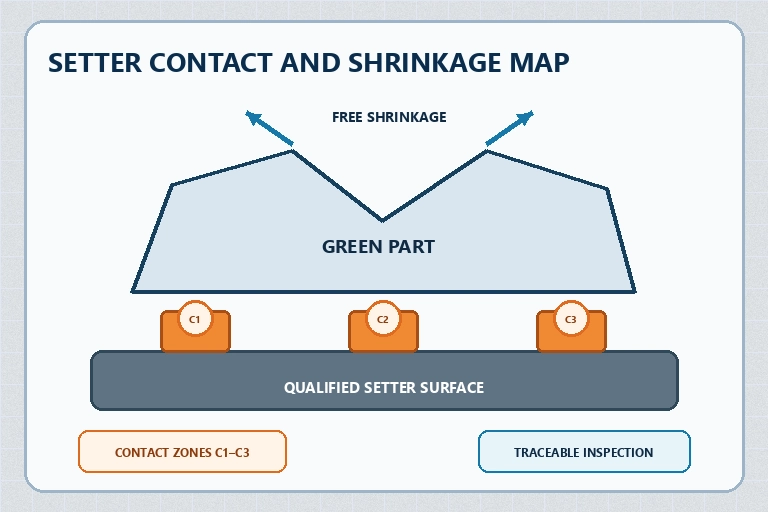
Keep the load map tied to setter identity. Assign each setter or qualified setter family a traceable code, orientation and allowed part position. Mark center, edge, upper, lower or shielded locations when atmosphere, temperature or vapor exposure may differ. If a part is rotated or moved to another pocket, the record should preserve that change so contact-side results can be compared with the actual support condition.
Review handling outside the hot zone. Loading tools, transfer carts, shelves and unloading methods can bend a setter or chip a contact surface before the cycle begins. Define inspection and rejection points where operators can see and feel the relevant surface without contaminating it. A setter that is dimensionally acceptable when cold can still require engineering review if a repaired or worn area changes the load path.
Separate setter compatibility from setter geometry
Evaluate chemical and mechanical fit as separate qualification surfaces. Setter chemistry, coating, porosity and previous exposure can influence sticking, color, carbon or oxygen balance, local composition and surface condition. Geometry, flatness, stiffness and thermal expansion influence support, friction, distortion and load stability. A setter material that is chemically compatible may still be too flexible or too rough for the part, while a dimensionally stable tray may introduce an unacceptable contact reaction.
Use the actual atmosphere and thermal route for evaluation. Vacuum, inert gas, partial pressure, hydrogen-containing atmosphere and evolved binder products can change which reactions or deposits are important. Consider the furnace hot-zone material and neighboring loads as part of the environment. Do not assume that a setter proven in one furnace, with one cleaning method, remains qualified after transfer to a different hot zone or shared-material schedule.
| Qualification surface | Evidence to retain | Risk addressed |
|---|---|---|
| Material and coating | Composition, supplier, grade, lot, coating or release-layer condition | Contact reaction, contamination, sticking or chemistry shift |
| Geometry and support | Drawing, flatness, contact map, stiffness, orientation and load limit | Imprint, constraint, sagging, cracking or distortion |
| Atmosphere and cycle | Vacuum or gas history, thermal record, volatile load and prior furnace condition | A compatible setter becoming reactive in a different environment |
| Reuse condition | Cycle count, cleaning, deposits, damage, dimensions and disposition | Gradual drift hidden by an unchanged part number |
| Part result | Contact-side inspection, free-surface comparison, dimensions and position identity | Acceptable averages hiding a repeated contact-side defect |
Control preparation and cleaning. A release powder, separator sheet, brushing method, abrasive cleaning or chemical wash can alter roughness, residual chemistry and porosity. Record the approved method and the condition after cleaning. If an operator has to improvise a coating thickness or use an unapproved tool to restore the surface, stop and route the setter for review rather than allowing maintenance to become an uncontrolled process variable.
Qualify load position, setter reuse and production variation
Use representative production loads, not only one carefully placed part on a new setter. Include the heaviest planned load, fragile geometry, maximum nesting density, relevant center and edge locations, upper and lower layers, normal gas-flow shielding and the oldest allowed setter condition. If different part families share the same furniture, demonstrate why the chosen challenge load represents their contact area, shrinkage path, volatile load and thermal mass.
Retain setter identity with every qualification and production batch. Record supplier and grade, drawing revision, coating or release layer, first-use date, cycle count or equivalent service history, cleaning events, repairs, dimensional checks, damage observations and part positions. Setter reuse should be released by defined condition and evidence, not by appearance alone or an arbitrary calendar interval.
Compare new and service-aged setters during development. A setter may change through deposit accumulation, coating loss, surface polishing, pore filling, warpage, cracking or local repair. Establish measurable or clearly defined rejection criteria for the surfaces and dimensions that matter. When a part result trends with setter age, protect the lot and investigate before extending the reuse limit.
Confirm handling and thermal cycling. Heavy trays or stacked setters can experience bending and contact damage during loading, bottom lifting or transfer. The qualification should represent the delivered furnace loading direction, shelf arrangement and support span. If a bottom-loading platform is used, verify how the load base, setter stack and work-zone position remain repeatable through the lift and seal sequence.
Define confirmation frequency from risk, not convenience. High-value parts, thin sections, contact-sensitive surfaces or multi-use furniture may justify more frequent dimensional or surface checks. Use retained evidence to adjust the interval, but do not broaden the limit after one favorable cycle. A change should have a documented technical basis and an approved disposition for parts already processed under the previous rule.
Diagnose contact-side defects without changing the recipe blindly
When a defect appears, compare the contact side, free surface and equivalent positions across the load. Record color, residue, adhesion, imprint, roughness, distortion, cracking, density, chemistry or other relevant evidence using the approved inspection method. A repeated contact-side signal points toward the immediate support system, but the setter is not automatically the only cause. Cleaning residue, binder vapor, atmosphere flow, hot-zone condition and material variation can produce similar observations.
Protect the original evidence. Identify the exact setter and pocket, orientation, neighboring parts, furnace position, recipe revision, gas or vacuum history, prior cycle, cleaning state and operator observations. Review whether the defect follows the setter, the position, the material lot or the furnace condition. Swapping setters and simultaneously changing temperature or atmosphere may recover the next batch while destroying the comparison needed to identify the mechanism.
Use controlled trials that isolate one credible variable at a time. Compare a qualified reference setter with the suspect item, or compare contact and non-contact coupons made from the same material when the method represents the production route. If destructive analysis is required, define the sampling location before cutting. A favorable center section does not resolve a defect that repeats at one edge support.
Link corrective action to requalification. Recoating, resurfacing, changing setter material, adding powder, opening gas paths, altering support spacing or lowering load mass can all change the qualified state. Document the change, intended mechanism, trial evidence and approved envelope before returning to routine production. This prevents a temporary shop-floor adjustment from becoming an undocumented standard.
Match the furnace and loading system to the setter plan
SYNHTE's Vacuum Sintering Furnace Systems cover pressed powders, hardmetals, ceramics, metal injection molding and binder-based additive manufacturing routes. The Multipurpose Vacuum Sintering Furnace supports configurable vacuum or protective-atmosphere cycles and selectable hot-zone approaches. The applicable configuration must be reviewed against setter chemistry, load mass, volatile species, contact geometry, work-zone position and the evidence needed to release parts.
Share the material and forming route, powder and binder information, green-part and setter drawings, contact or coating system, load mass, setter stack height, atmosphere, thermal program, expected shrinkage, surface and dimensional acceptance, reuse plan, production volume, data-retention needs and site handling constraints. Ask how chamber access, loading direction, hot-zone materials, gas flow, vapor management, pumping, controls and load support preserve the defined setter condition.
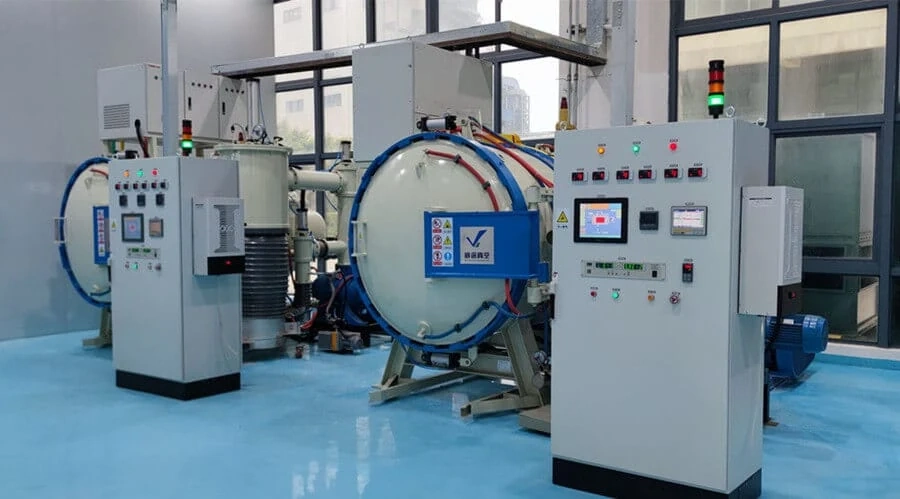
For large or heavy setter stacks, compare the Bottom-Loading Vacuum Sintering Furnace and define how the load base, lift, hot-zone entry and final position remain repeatable. Bottom loading can change handling and support decisions, but it does not remove the need to qualify individual contact surfaces and load positions.
Put setter evidence into the technical agreement: permitted materials and coatings, load drawings, maximum mass and stack, cleaning and inspection, spare furniture, factory test basis, representative material trial, load-position records, training and site acceptance. Define engineering review or requalification after a new material or binder, setter supplier or grade, coating, drawing, repair method, cleaning process, load mass, position, atmosphere, hot zone, loading direction, major maintenance event or unexplained contact-side defect.
Multipurpose Vacuum Sintering Furnace
The multipurpose vacuum sintering platform supports material-specific vacuum or controlled-atmosphere routes with configurable hot-zone and loading arrangements. Setter material, tray geometry, load mass, vapor behavior and contact-surface evidence must be reviewed together with the actual powder, binder system and acceptance plan.
What to include in your enquiry
- Exact material, incoming condition and governing drawing or specification
- Part, interface, fixture, stack and production-load drawings
- Required process outcome, acceptance methods, limits and sample locations
- Current process route, fixed variables, development questions and known risks
- Batch volume, data-retention needs, utilities, site interfaces and delivery requirements