Copper Vacuum Annealing: Load Design, Surface Control and Qualification

Copper vacuum annealing should be qualified around the exact alloy, incoming temper, cold-work history, target properties, surface requirement and production load. Control residues before heating, keep parts separated on a repeatable fixture, verify representative part temperature rather than relying only on the furnace setpoint, and release the route with dimensional, property, appearance and traceable cycle evidence.
Define the copper alloy, incoming temper and required outcome
Start by identifying the exact copper or copper-alloy designation, product form, incoming temper, cold-work history, section thickness and relevant drawing or material specification. The word copper covers materials with different alloying additions and different responses to heat. A route that produces the intended condition in one wrought copper grade cannot be transferred automatically to a copper-nickel alloy, precipitation-hardenable copper alloy or plated component.
State the purpose of annealing in measurable terms. The requirement may involve stress relief, softening, recovery of ductility, recrystallization, forming performance, electrical or thermal function, dimensional stability or a controlled surface appearance. These outcomes do not always require the same thermal exposure. Define which properties or inspections release the part, which surface changes are unacceptable and whether grain size, hardness, tensile behavior, conductivity, flatness or another characteristic is controlled.
Connect the requirement to the part history. Prior reduction, forming, machining, joining, coating and storage can change the starting condition. Separate development samples by material lot and processing history so the furnace study is not asked to explain uncontrolled incoming variation. Use the material supplier's data, applicable specification and engineering trials to set the qualified temperature-time window; do not adopt one published temperature as a universal copper vacuum annealing recipe.
Control surface condition before heating
Vacuum reduces the availability of oxygen during the cycle, but it does not remove machining oil, drawing lubricant, fingerprints, polishing compound, cleaning residue or packaging contamination. Some residues can outgas, leave a carbonaceous film, stain the surface or contaminate fixtures and the hot zone. Define an approved cleaning sequence for the actual soil and material, including rinsing, drying, gloves or tools, protected storage and the maximum time from final cleaning to furnace loading.
Inspect parts before they enter the furnace. Record appearance, water break or another relevant cleanliness check when required by the process, and reject trapped liquid or residue in blind features. Keep copper separate from dirty carbon steel tooling, shop rags and uncontrolled marking materials. If an anti-stick layer, separator or support material is needed, its chemistry, thickness, placement and compatibility must be part of the qualified route.
Protect the clean state during loading. Use dedicated handling surfaces and identify fixtures so previous processes cannot introduce cross-contamination. A clean-looking fixture may still retain residue from an earlier load. Maintenance and bake-out decisions should follow the furnace supplier's guidance and the facility's process controls. When discoloration appears, preserve the part, fixture identity, cleaning record, loading time, vacuum history and thermal record before changing the recipe; otherwise the team can confuse a surface-preparation problem with a furnace-pressure problem.
Design a representative load and sensing plan
Load geometry changes heat transfer and the time required for the part to follow the programmed cycle. Arrange parts so critical surfaces remain supported, pieces do not nest unintentionally and thermal radiation or selected cooling flow is not blocked. Record fixture material, contact area, tray level, part spacing, orientation, center and edge positions, total load mass and the mix of thin and heavy sections. A lightly loaded development tray may not represent a dense production batch.
Select representative temperature-sensing locations when load measurement is required by the procedure. The center of the furnace is not automatically the slowest or most critical point. A heavy section, shielded surface, lower tray or close-packed region may respond differently from an exposed edge. Attach and route sensors in a way that measures the intended part or fixture location without creating a new contact, heat sink or movement risk. Document sensor type, attachment, channel and part position.
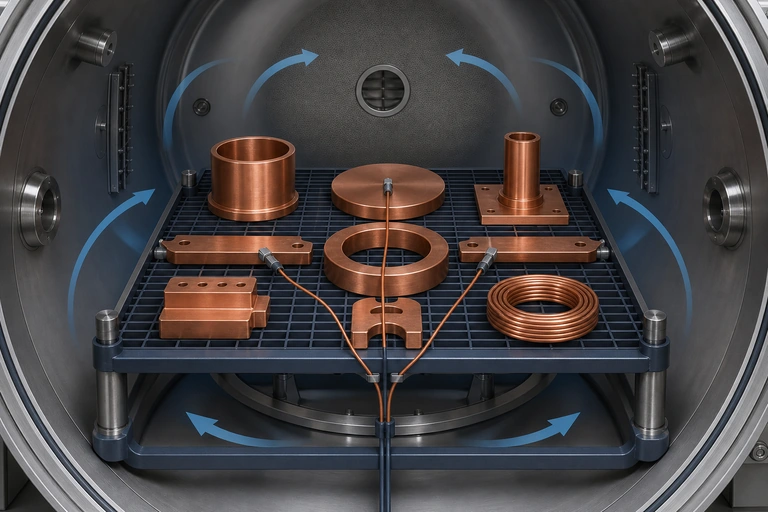
Define the permitted load envelope after confirmation trials. Include the allowed part family, mass range, tray arrangement, spacing, fixture, work-zone position and sensor strategy. If production needs several load patterns, qualify the important patterns or justify why one challenge load covers them. Operators should not need to guess whether adding another layer, nesting a different geometry or substituting a heavier fixture remains inside the approved state.
Qualify the cycle with part-based acceptance evidence
Define pump-down, heating, soak, vacuum or selected atmosphere control, cooling and unload conditions from the material procedure and part requirement. Furnace setpoint achievement alone does not prove that a representative copper part received the required exposure. Review part or load temperature evidence when it is part of the qualification plan, and distinguish programmed values from measured responses. Set deviation rules for pressure excursions, interrupted heating, sensor failure, extended hold or delayed cooling.
Build acceptance around the stated outcome. Use the required dimensional, hardness, conductivity, tensile, forming, grain-size, surface or other inspections for the material and drawing. Not every test is needed for every part, but each selected test should answer a defined release question. Preserve sample and load position so an acceptable average does not hide a center-to-edge or thin-to-heavy difference.
| Gate | Evidence to retain | Question answered |
|---|---|---|
| Starting material | Alloy, temper, cold-work history, lot and incoming condition | Did the trial begin from a controlled state? |
| Surface and loading | Cleaning record, fixture, spacing, orientation, mass and load map | Were contamination and heat-transfer inputs repeatable? |
| Cycle execution | Vacuum or atmosphere history, thermal response, alarms and cooling | Did the representative load receive the approved exposure? |
| Final acceptance | Required properties, dimensions, surface result and position identity | Did the process deliver the specified material and part outcome? |
Run enough confirmation work to include normal variation in incoming material and production loading. Define recipe access, record retention, review responsibility and reaction to an outlier before routine release. When a result fails, protect the original evidence. Changing temperature, hold time and cleaning together may produce another acceptable part, but it will not identify which mechanism was responsible.
Control cooling, unloading and change management
Cooling is part of the qualified route. The allowable rate and end condition depend on alloy, section, target properties, fixture restraint and distortion risk. Define when cooling transitions occur, when the load may be exposed to air and when parts may be handled without damaging a soft or dimensionally sensitive condition. Avoid treating the end of the heating hold as the end of the process record.
Inspect the unloaded parts under defined conditions. Appearance can change with lighting, handling and storage, so use the agreed inspection method and timing. Protect clean surfaces from fingerprints, condensation and incompatible packaging. If additional forming, machining, plating or joining follows, state the storage limit or protection needed between operations. A qualified anneal can still be undermined by uncontrolled post-furnace handling.
Define requalification or engineering-review triggers for a changed alloy or temper, material supplier condition, part thickness, cold-work route, coating, cleaning method, fixture, load mass, spacing, work-zone position, furnace or hot zone, sensor arrangement, cooling route or major maintenance event. Trending final properties and surface observations against material lots, load maps and cycle records can reveal drift before it becomes a release failure.
Match the furnace to the copper load and evidence plan
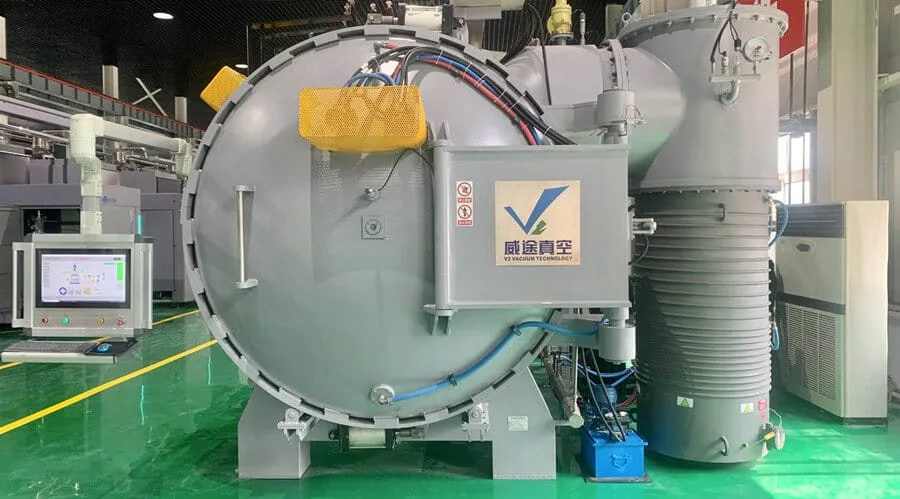
SYNHTE's Vacuum Heat Treatment Furnace range includes a Vacuum Annealing Furnace configured for clean batch annealing, stress relief and bright heat treatment. The current product page describes vacuum or protective-gas operation, selectable hot-zone approaches, programmable cycles and gas cooling. The applicable configuration must be reviewed against the copper alloy, surface target, usable work zone, fixture, load mass, temperature-evidence plan, cooling requirement and facility utilities.
Share the exact alloy and temper, incoming process history, part and fixture drawings, batch mass, load pattern, target properties, surface acceptance, planned sensors, inspection methods, production volume, data-retention needs and site interfaces. Ask how the proposed hot zone, pumping, loading access, controls and cooling route support those inputs. When the process window is still being developed, a controlled heat-treatment service discussion can help define representative trials before the equipment scope is fixed.
Vacuum Annealing Furnace
This furnace family supports clean batch annealing, stress relief and bright heat treatment under vacuum or a selected protective atmosphere. The useful configuration is chosen from the alloy, load, surface target, work zone, cooling route and qualification evidence.
What to include in your enquiry
- Exact material, incoming condition and governing drawing or specification
- Part, interface, fixture, stack and production-load drawings
- Required process outcome, acceptance methods, limits and sample locations
- Current process route, fixed variables, development questions and known risks
- Batch volume, data-retention needs, utilities, site interfaces and delivery requirements