
Bright Vacuum Annealing of Stainless Steel: Process Controls That Protect Surface Finish
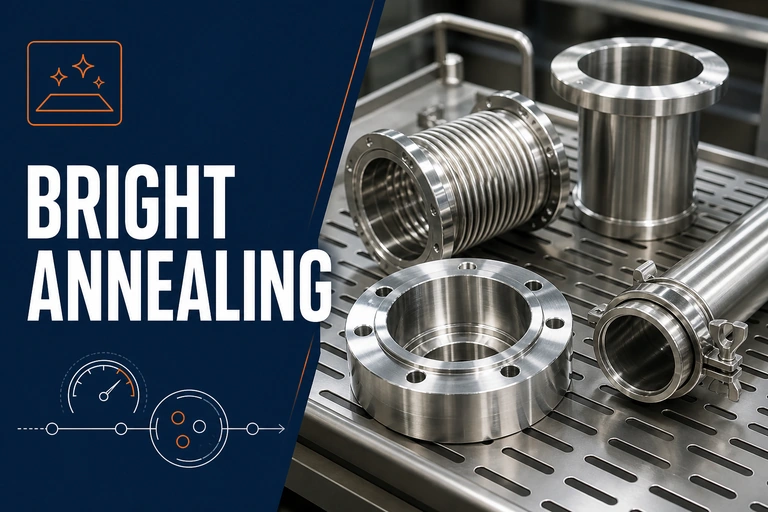
Bright vacuum annealing stainless steel depends on clean incoming material, a suitable vacuum condition, controlled thermal exposure and careful cooling. Surface protection is a process outcome that must be planned before the cycle begins.
Bright Vacuum Annealing Stainless Steel: First Controls
Bright vacuum annealing of stainless steel depends on a clean starting surface, an appropriate thermal cycle, controlled furnace condition and a cooling method compatible with the grade and final requirement. “Bright” is a result to validate; it is not guaranteed by the word vacuum alone.
What bright annealing controls
Annealing can relieve work hardening, adjust microstructure and restore ductility after forming or cold work. For stainless steels, surface appearance and corrosion-related performance also depend on the alloy, contamination control and thermal history. The process must be selected for the actual grade and product condition rather than applying a generic cycle to every stainless part.
Vacuum helps reduce exposure to oxygen-bearing gases, but it cannot remove oils, polishing compounds, chlorides, machining residue or trapped contaminants already carried into the chamber. Cleaning and handling are therefore part of the thermal process.
The control points to define
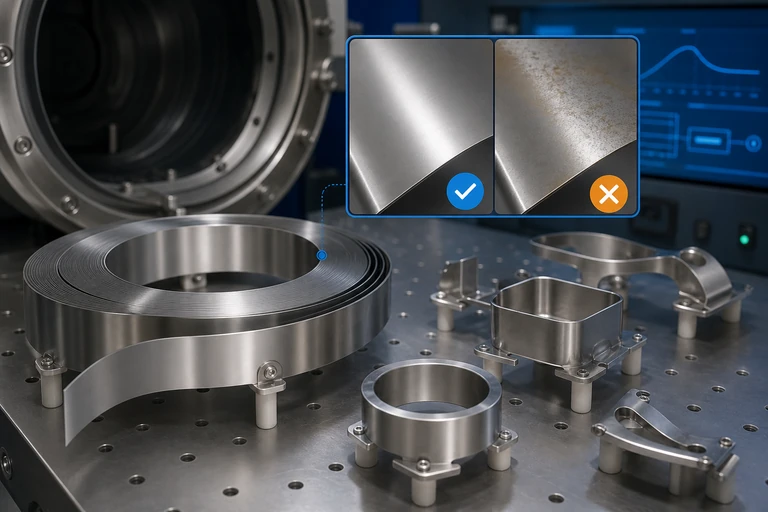
This comparison highlights why cleanliness and controlled handling are part of the surface-protection plan.
| Control point | Why it matters | What to document |
|---|---|---|
| Stainless grade and condition | Different grades and cold-work conditions respond differently | Material certificate, starting hardness and process history |
| Surface preparation | Residue can affect appearance and furnace cleanliness | Cleaning route, handling and packaging condition |
| Temperature and hold | Controls the intended metallurgical change | Qualified temperature range, hold and load condition |
| Vacuum and atmosphere condition | Supports surface protection and repeatability | Pressure targets, gas steps and maintenance condition |
| Cooling and handling | Can affect colour, distortion and downstream readiness | Cooling route, unloading temperature and post-process handling |
Clean before heating
Process residue is often the first correctable cause of uneven colour or furnace contamination. Confirm that incoming parts, fixtures and baskets are compatible with the cleaning route and are dry before loading. Avoid treating a cleanliness problem as a temperature adjustment; the latter may change the metallurgical result without removing the source of the defect.
Planned inspection of seals, pumps, cooling systems and hot-zone condition supports stable operation. Use the Vacuum Furnace Preventive Maintenance Checklist to connect process hygiene with routine equipment care.
Qualify the surface and the material result
- Identify the exact stainless grade, incoming condition and critical finished properties.
- Define the cleaning and handling state before loading.
- Use a repeatable fixture, load density and work-zone location.
- Record the vacuum condition, thermal cycle and cooling route.
- Inspect appearance together with the specified mechanical, dimensional and corrosion-related requirements.
- Review changes in material source, cleaning, load arrangement or maintenance condition before reuse of the recipe.
Where temperature evidence is a contract requirement, pair the process with the Temperature Uniformity and TUS Guide and define what it proves for the actual work zone.
A stainless-steel annealing system should be reviewed for the intended grade, load geometry, surface-cleanliness requirement, thermal range, vacuum performance, cooling route and documentation. A nominal maximum temperature does not replace those process inputs. For cross-process equipment selection, start with Vacuum Furnace Systems, then use the Vacuum Heat Treatment Furnace system family when the annealing specification must be compared with related thermal-processing requirements.
For an application-specific configuration, review the Vacuum Annealing Furnace when the annealing work needs equipment matched to the stainless grade, load geometry, surface requirement and cooling route.
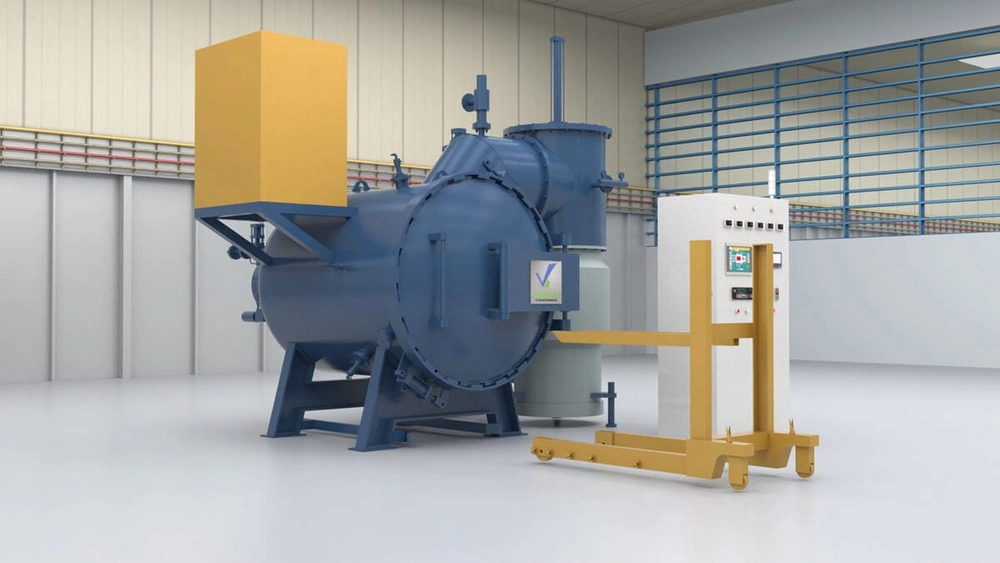
Vacuum Annealing Furnace
Configuration should connect the material, surface target, work-zone size, thermal cycle and cooling method to a repeatable production process.
- Clean-process vacuum configuration
- Load and work-zone review
- Data recording for qualified recipes
What to include in your enquiry
Share the material and final part requirement for a useful annealing-system review.
- Stainless grade, incoming condition and material certificate
- Part drawing, surface-finish target and permitted distortion
- Cleaning method, residue risks and fixture details
- Temperature range, cycle time, vacuum or gas requirements
- Required inspection, records and production quantity
Technical references
- ASTM A380/A380M — Cleaning and Passivation of Stainless Steel — official ASTM practice for cleaning, descaling, pickling and passivation considerations that affect stainless-steel surface condition.
- AIAG CQI-9 — Special Process: Heat Treat System Assessment — official AIAG heat-treatment system-assessment reference for controlled process operation.