Vacuum Furnace Recipe Verification: Start, Soak and Cooling Events
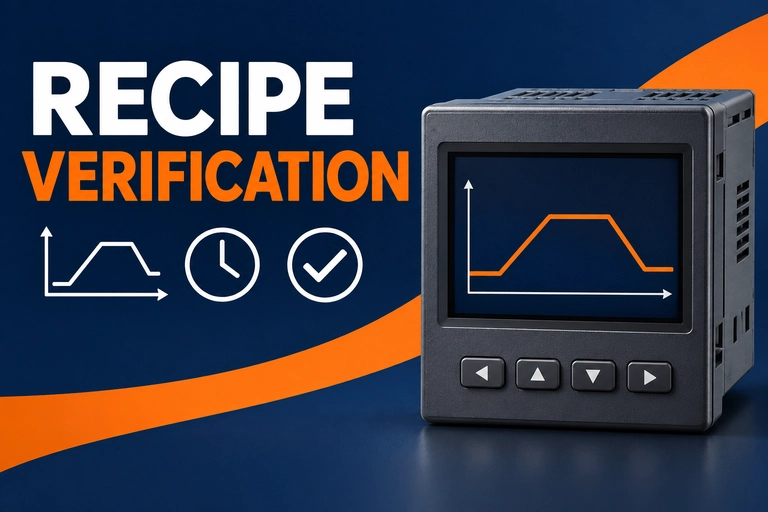
Vacuum furnace recipe verification checks what the control system will execute, not just whether the saved curve looks familiar. Confirm the recipe identity, start condition, segment-time meaning, soak logic, process events and interruption response against the installed configuration. Then connect the execution record to representative load evidence. Matching peak temperature and nominal dwell alone does not establish that two programs deliver the same process.
Freeze the recipe identity before comparing numbers
Begin with the approved process instruction and the actual furnace. Record the recipe identifier and revision, product family, controller model, software or firmware identity, applicable configuration and authorization to change it. Preserve the existing approved program before entering or transferring a revision. A program number identifies a storage location; it does not prove which revision occupies it.
Define the boundary of the change. Re-entering a curve after controller replacement, copying it to another furnace and changing one dwell are different verification tasks. Input scaling, engineering units, output assignments and enabled options can alter execution even when the visible segment list is identical. A comparison should therefore include the configuration on which the recipe depends, not only an exported list of temperatures.
Use an independent review appropriate to the consequence of the change. Compare the intended instruction with the program read back from the device or authorized software. Keep the person, date, revision and discrepancy disposition with that record. Do not resolve an unexplained mismatch by editing the approved instruction to match whatever is already stored.
Check what start and segment time actually mean
A ramp can be defined by a rate, a time to a target, or another model-specific rule. A step may instead request an immediate setpoint change. These choices are not interchangeable. Check the selected segment type and time units before deciding that a copied number is correct. Include the initial setpoint, selected starting segment and any permitted start-from-measured-value behavior.
Inspect repeats and loops as execution paths. A repeated block can revisit a temperature or event that is not obvious from a single plotted pass. Confirm the first and last included segments, repeat count and final program state. The verification record should describe the intended path in plain language so that a reviewer can compare it with the executed segment history.
| Field | Question | Evidence to retain |
|---|---|---|
| Start and segment time | Which initial condition and timing rule apply? | Read-back segment type, units and approved start definition. |
| Soak and hold behavior | Which input and deviation condition can affect progression? | Configured function, governing channel and observed transition. |
| Event and program end | What changes, when, and to which final state? | Event mapping, execution history and relevant feedback. |
Do not import defaults from a different controller example. A zero timer, an OFF selection or a retained value may have a specific meaning in the installed version. Resolve that meaning through the correct manual and configuration. If it cannot be established, keep the revised recipe out of production rather than assuming the function is disabled.
Separate guarantee-soak logic from load qualification
Some programmers can delay progression when the measured process value has not satisfied a configured condition. Shimaden's technical explanation describes guarantee soak as compensation for program-following delay; Eurotherm describes holdback among its programming functions. These are examples of available control behavior, not evidence that every furnace implements the same timer, band or release rule.
Trace the configured input back to its physical measuring junction. A chamber-control junction, a surface junction and a junction inside a heavy section represent different locations. A timing function that responds correctly to one input cannot prove that all critical joints have reached the required condition. The illustration separates measurement locations without prescribing a sensor installation.
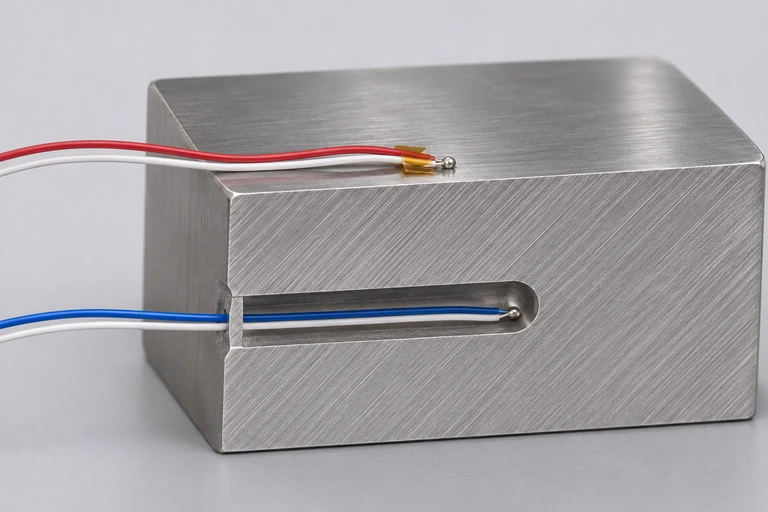
Write down which channel governs progression, the permitted deviation, the relevant time condition and the response to an invalid signal. Check these against the installed instructions rather than assuming that a familiar function name defines them. Keep programmer verification separate from production-load thermocouple qualification, which establishes whether the selected temperature evidence represents the component.
Use the approved verification method to observe the transition and preserve its time basis. Identify programmed setpoint, measured input, active segment and any hold state in the record. A smooth temperature chart without these identities may hide why the program waited or advanced. Do not alter sensor bias or widen a band merely to make a verification run progress.
Follow the cooling event beyond the controller
A recipe event is a request within a larger control system. Its meaning depends on output assignment, interface logic and the equipment it addresses. A timed output may be associated with cooling or another process function, but the same output number on a different machine may do something else. Verify the actual mapping against the furnace documentation.
Separate the controller command, the physical actuator state and the feedback used to confirm it. A relay indicator can show a command while a valve has not reached its intended position. Conversely, a position signal does not by itself establish gas flow, pressure or adequate cooling. Each observation answers a different question; establish their relationship from the installed documentation.
Define what the event should do during a normal segment transition, a hold, an aborted program and program completion. Record any conditions that must permit the action and how failure is detected. Do not assume that the event clock continues, pauses or resets in the same way as the temperature program. Establish the installed behavior from its documentation and an agreed safe test.
Keep recipe events distinct from protective functions. A production cooling request must not replace the required cooling-water protection or independent overtemperature response. Refer to the cooling-water interlock acceptance guide for that separate protection boundary. Never defeat a permissive or force a live output to obtain a convenient screenshot.
Prove interruption behavior without sacrificing the load
Determine the approved response to power loss, communication loss, operator hold, sensor failure and abort before running a revised recipe. These events need not produce the same recovery. Establish whether the intended action is to remain stopped, resume under defined conditions or require a reviewed restart. A controller's ability to retain data does not authorize automatic continuation of a metallurgical process.
Use a manufacturer-approved simulation or controlled verification arrangement with authorized personnel. Do not deliberately remove power, cooling or vacuum from a hot production furnace to explore an undocumented recovery setting. The test plan must preserve the equipment's protective functions and define the safe state, acceptance observations and stopping rule in advance.
Record the interruption point, actual state, output response, alarms, recovery decision and any affected product disposition. Repeating a segment after an interruption can change cumulative thermal exposure. Resuming at the next segment can omit required exposure. Neither action is acceptable simply because the interface permits it; the process and equipment procedures govern release.
Release the recipe with traceable execution evidence
Close vacuum furnace recipe verification with the approved revision, device read-back, configuration identity, reviewer, execution path and resolved discrepancies. Link that package to the representative load, calibrated measurement chain, temperature and vacuum records, relevant event feedback and product acceptance results. State which conditions were demonstrated and which remain outside the verified scope.
A successful empty or simulated run verifies only the behavior it reproduces. It does not establish joint quality under production mass, loading and material variation. Conversely, one acceptable assembly does not prove every interruption branch or output mapping. Keep program-function evidence and process-qualification evidence connected without treating either as a substitute for the other.
Within SYNHTE's vacuum brazing furnace systems, discuss the High-Temperature Vacuum Brazing Furnace only for a compatible material and batch route. Ask how the delivered configuration supports the required recipe access, recording and interface evidence. Define the actual process and recovery requirements before assuming a catalogue controller function supplies them.
High-Temperature Vacuum Brazing Furnace
For a compatible high-temperature batch brazing route, review recipe permissions, temperature and vacuum records, process-event interfaces and recovery documentation against the delivered control configuration. A controller function alone does not qualify a joint, prove valve movement or establish a safe recovery sequence.
Prepare the engineering evidence
Provide the material and filler route, load and fixture drawings, approved process window, controller and software identity, recipe revision, sensor assignment, event list, interruption policy and required acceptance records. Identify the execution behavior that remains uncertain before requesting a control-system change.
Technical references
- Shimaden: programmable-controller technical questions — Manufacturer explanations of guarantee soak and event/alarm functions; installed model instructions remain controlling.
- Eurotherm: setpoint programming functions — Manufacturer description of segment/event integration, holdback and recovery capabilities for its own system, not a SYNHTE configuration claim.