
Titanium Diffusion Bonding: Surface Preparation, Pressure and Cycle Development
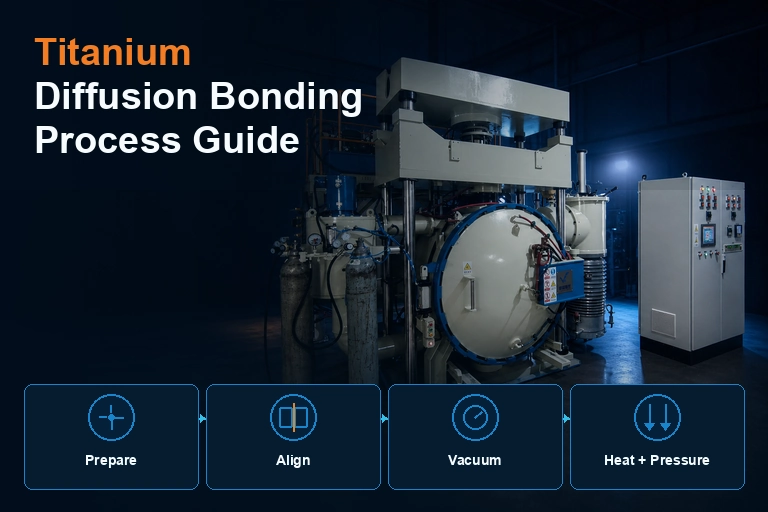
Titanium diffusion bonding joins prepared surfaces by intimate contact, elevated temperature, controlled pressure and time. It is attractive for assemblies where a clean solid-state interface, low distortion and a controlled thermal history are important. It is also unforgiving: the final interface reflects surface condition, flatness, fixture stiffness, pressure distribution, temperature uniformity and vacuum cleanliness.
| Control | What it influences | Evidence to record | Common risk |
|---|---|---|---|
| Surface preparation | Oxide condition and true contact area | Cleaning route, elapsed time and handling | Recontamination before loading |
| Pressure and tooling | Interface contact and dimensional stability | Force/pressure trend and tooling condition | Uneven load or local indentation |
| Temperature and time | Diffusion and interface closure | Calibrated temperature record and hold | Grain growth or distortion |
| Vacuum / atmosphere | Surface protection and contaminant removal | Pressure trend and leak performance | Oxygen, moisture or tooling outgassing |
Titanium diffusion bonding starts with surface preparation
Surfaces must be flat enough to make real contact under the planned pressure and clean enough to avoid oils, handling contamination and persistent oxide barriers. Define the machining or finishing method, cleaning sequence, allowable time before loading, handling method and inspection. Do not leave these choices to informal operator practice.
Different titanium grades, mating materials and joint shapes may require different preparation and protection approaches. Use a qualified material/process plan rather than transferring a surface recipe from another alloy or supplier unchanged.
Temperature, pressure and time work together
There is no universal titanium diffusion-bonding cycle. Higher temperature, greater pressure or a longer hold can improve bonding progress, but each may also affect deformation, microstructure, dimensional control or interface behavior. The suitable window depends on alloy, joint design, contact area, surface finish, load path and the required properties.
Develop the window with a designed qualification trial. Measure temperature at meaningful locations, verify actual pressure at the interface where possible, and test the bonded joint using the acceptance method required by the application. Treat published parameter ranges as research starting points, not production instructions.
Vacuum and load control matter at the interface
Vacuum reduces the risk of contamination during the high-temperature hold, but it does not repair poor contact or contaminated surfaces. The furnace, press tooling and fixture must hold alignment and deliver pressure evenly over the real contact area. Uneven compliance, warped platens or an unsupported assembly can create local unbonded zones even when the controller displays the programmed force.
For hollow structures or large panels, design the load path and any stop-off/non-bond areas early. Ask how pressure reaches every intended bond and how trapped volumes are handled during evacuation and heating.
A disciplined development plan
- Define alloy, part condition, geometry, surface-finish requirement and acceptance test.
- Produce and inspect preparation coupons before using valuable assemblies.
- Establish a trial matrix for temperature, pressure, hold time and surface condition.
- Record actual furnace temperature, vacuum trend, force/pressure, fixture configuration and load layout.
- Section or non-destructively inspect representative joints, then confirm mechanical/dimensional performance.
- Freeze the qualified recipe, fixture and handling instructions; control changes formally.
Do not treat all pressure-assisted or joining furnaces as interchangeable. A vacuum hot press furnace is relevant when the main objective is pressure sintering, densification or thermo-mechanical consolidation. A high-temperature vacuum brazing furnace follows a filler-based joining route instead of solid-state diffusion bonding. The interface design and acceptance method should determine which process family applies.
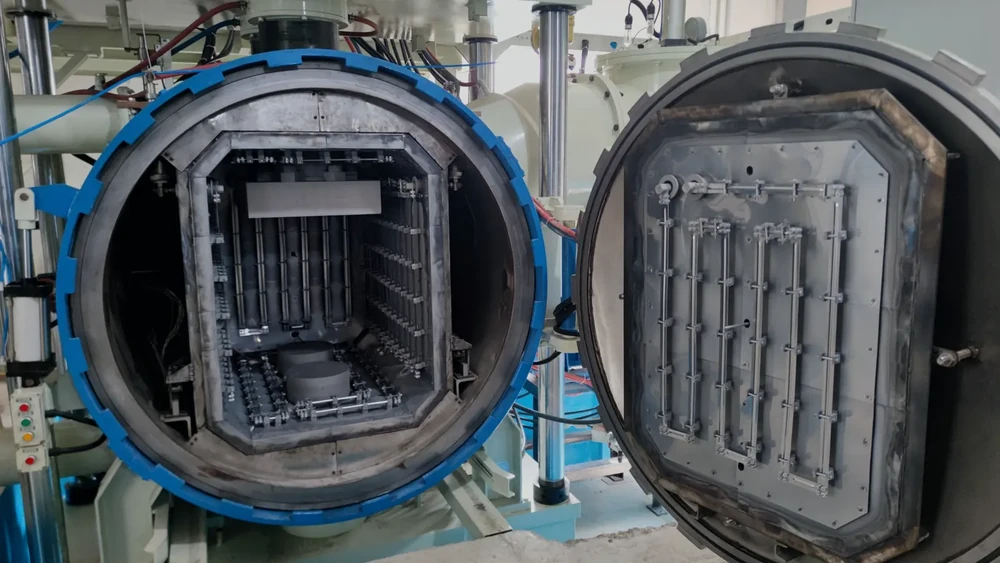
Vacuum Diffusion Bonding and Brazing Furnace
A diffusion-bonding system must coordinate the hot zone with force application, tooling access, alignment, vacuum performance and data acquisition. Review the required pressure distribution at the component—not only the nominal machine force.
- Synchronized force and temperature
- Vacuum-protected interface
- Tooling access and process records
Specify the equipment with the process evidence
For a diffusion-bonding furnace proposal, provide the material combination, maximum contact area, pressure requirement, work-zone dimensions, temperature range, tolerance, vacuum requirement, load mass, tooling concept, inspection method and planned throughput. This allows the system to be designed around temperature uniformity, press force, platen geometry, controls and traceability.
SYNHTE’s vacuum diffusion bonding and brazing furnace is intended for projects that need controlled pressure and clean thermal cycles. Send a drawing and process requirement to contact SYNHTE for an application review.
What to include in your enquiry
These details let the engineering team respond with a relevant configuration instead of a generic catalogue answer:
- Titanium grade and starting material condition
- Bond area, stack height and component drawing
- Target interface quality and dimensional limits
- Proposed temperature, pressure and time window
- Tooling concept, production volume and inspection method
Review pressure, temperature and tooling together
Provide the titanium grade, contact area, target pressure, work-zone dimensions, vacuum requirement, tooling concept and inspection method. Send the diffusion-bonding requirement to SYNHTE.