MIM Residual Carbon: Sampling After Debinding and Sintering
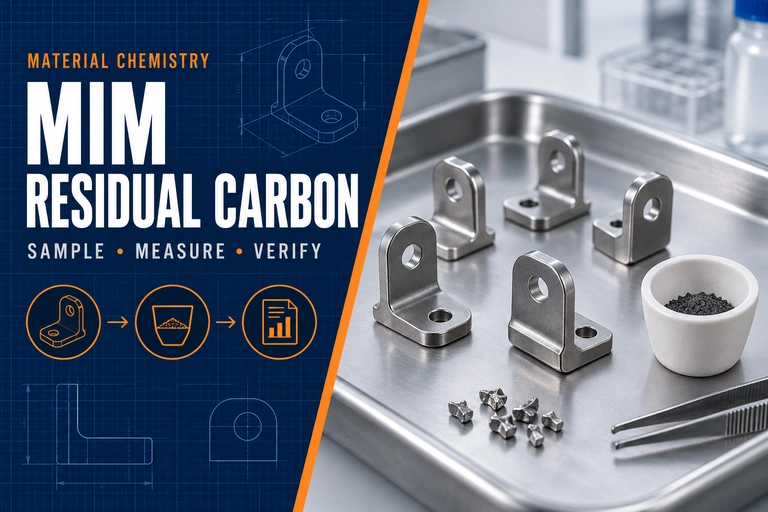
MIM residual carbon must be reported with the material, process state and sampling location. Debinding weight loss can track removal of binder, but it cannot replace a final carbon analysis. Define the required sintered chemistry, use a suitable validated laboratory method and connect each result to the part and furnace load it represents.
Define which carbon result the specification needs
In metal injection molding, the phrase residual carbon can refer to different questions. A development team may be investigating binder-derived residue after thermal debinding, while a customer may require the total carbon content of the finished alloy. Those results cannot be compared without identifying the specimen state and analytical basis. Include that definition in the laboratory request.
Start with the actual feedstock designation and the required final material specification. Stainless grades such as 316L, 17-4 PH and 420 do not share one carbon acceptance target. A process intended to preserve carbon in one material may be inappropriate for another. The drawing, purchase requirement or approved material standard must establish the applicable final limit.
A total-carbon measurement does not, by itself, identify where the carbon originated or how it is distributed among different constituents. Avoid reporting every measured carbon atom as unremoved polymer. Investigation of the source requires process history and, where appropriate, additional material examination. Keep the chemistry acceptance decision separate from the explanation of its cause.
Use debinding mass loss as a process indicator
Weighing can help track the progress and consistency of binder removal, provided the procedure defines conditioning, handling and the relevant starting mass. It is a process indicator tied to the selected binder system. A stable mass-loss result does not establish that all sampled regions will reach the same carbon content after sintering.
Separate the preliminary debinding stage from subsequent thermal removal of the remaining binder component when the feedstock route uses both. State exactly when a brown-part specimen was taken. A sample removed after one stage should not be labelled fully debound simply because it can be handled or has reached the expected appearance. Use the feedstock supplier’s process definitions.
Review inconsistent mass results for handling loss, retained liquid, specimen mix-ups or changes in conditioning before assuming a furnace chemistry problem. Conversely, do not discard a chemistry discrepancy because the batch lost the expected mass. These measurements answer different questions, and both can be useful when their scope and uncertainty are documented.
Expect carbon chemistry to continue changing during sintering
Carbon can be affected by binder decomposition and by reactions involving oxygen in the powder or atmosphere. Published work by Lou and coauthors on MIM 420 stainless steel also shows that densification and pore closure can change the way carbon is removed and distributed. These observations explain why a brown-part result and a sintered-part result are not interchangeable.
Do not transfer that paper’s temperatures, carbon profile or removal rate directly to another feedstock. Powder chemistry, binder, section thickness, atmosphere and the complete cycle form a different system. For development, compare matched specimens taken from defined stages and keep the final sintered chemistry as the release endpoint when that is what the product specification requires.
Record the relevant furnace conditions alongside the samples, including the intended gas and pressure sequence and any deviations. A pressure trace does not identify carbon content, but it can help locate when the actual process departed from the approved route. Investigation is stronger when material and equipment records share the same batch identity.
Keep surface, core and load position identifiable
Select specimens according to the question being investigated. A whole small component, a surface-adjacent portion and a core portion can produce different representations of the part. Define whether the requested result is a bulk average or a location-specific investigation. Include the cut plan, minimum usable sample quantity and preparation constraints agreed with the laboratory.
Mark the specimen origin on a part section before cutting. A surface-adjacent specimen and a core specimen answer different location questions, whereas combining both into one analytical portion produces an average for that mixture. The drawing shows location identity only; it does not predict which region contains more carbon in a particular feedstock or furnace cycle.
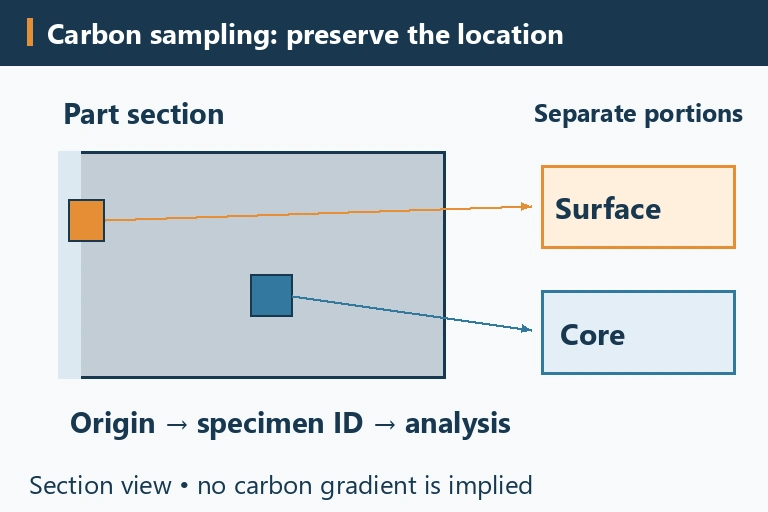
Carry the same discipline into the load map. Record tray, position, orientation and the identities of companion specimens. A pooled sample may be useful for an explicitly defined average, but it cannot establish the most extreme local result. During qualification, select positions from the process risks rather than only from the most accessible tray.
Agree the analytical method and preparation with the laboratory
Combustion analysis with infrared detection is an established approach for carbon in steel. ASTM E1019 covers relevant carbon determination methods for steel and related alloys, while instrument suppliers such as LECO provide application guidance. Ask the laboratory to identify the selected method, applicable range, calibration controls and reporting basis for the actual material submitted.
A method validated for a solid sintered steel specimen should not be assumed valid without review for a porous brown part containing appreciable organic residue. Discuss the matrix and sample condition before shipping specimens. The laboratory should determine whether additional method development or a different preparation is required, and report that distinction with the result.
Prevent sample preparation from becoming an uncontrolled carbon source or removal step. Agree how oils, cutting residues and other surface contamination are handled, and whether any removed surface is part of the feature under investigation. Keep preparation records with the sample identifiers. Request the laboratory’s quality-control evidence and measurement uncertainty where needed for the acceptance decision, especially near a specification boundary.
Investigate a mismatch without averaging it away
When carbon is outside the required range, first verify specimen identity, state, units and the applicable limit. Review the analytical quality checks and any preparation anomaly. Retain the original result when a repeat is requested. A second specimen from a different location is new evidence, not an automatic replacement for the first result.
Compare the affected load with feedstock lots, debinding records, furnace conditions and previous acceptable batches. Separate a suspected material-lot change from a tray-position pattern or a laboratory preparation issue. Additional sampling should test a specific explanation and define the affected population. Avoid combining unrelated results until the source of the difference is understood.
A chemistry pass does not automatically establish density, dimensional accuracy or mechanical performance. Likewise, passing those other checks does not release an out-of-specification carbon result. The final material package should connect all required characteristics to the same approved process and batch, with any concession handled by the responsible acceptance authority.
Build the carbon evidence plan into the MIM furnace enquiry
Use the Vacuum Sintering Furnace range to compare process routes. For an integrated binder-removal and sintering project, review the MIM Vacuum Debinding & Sintering Furnace with the actual feedstock, binder load, tray arrangement and atmosphere requirements. Discuss the collection system and cycle records in relation to the material evidence needed for qualification.
The equipment view relates the sealed chamber and tray-loading arrangement to the control cabinet. Those visible interfaces help define how specimens remain associated with their production load and how the debinding and sintering records are recovered for the same batch.

Supply the required final chemistry, sampling plan and laboratory method along with the production requirements. Confirm which variables will be developed during trials and which are fixed by the feedstock or product specification. That makes the acceptance discussion concrete without treating a programmed recipe or vacuum specification as proof of final carbon content.
MIM Vacuum Debinding & Sintering Furnace
Discuss binder removal, atmosphere transitions, load arrangement and process records using the actual feedstock and chemistry acceptance plan. An equipment recipe library supports process setup; final material chemistry still requires part-specific verification.
What to include in your enquiry
- Exact material, incoming condition and governing drawing or specification
- Part, interface, fixture, stack and production-load drawings
- Required process outcome, acceptance methods, limits and sample locations
- Current process route, fixed variables, development questions and known risks
- Batch volume, data-retention needs, utilities, site interfaces and delivery requirements