
Diffusion Pumps for Vacuum Brazing: Design and Upgrade Checks
Diffusion pumps can provide the high-vacuum stage in a vacuum brazing system, but a larger pump or a newer heater does not automatically improve the production result. The useful question is whether the complete pumping package can support the required process pressure, cleanliness and cycle time with dependable protection and maintainable components.
It should demonstrate adequate chamber performance under a defined load, compatible backing capacity, effective cooling and heater protection, and an acceptable maintenance burden. Compare evidence from equivalent operating conditions. Treat energy savings, pumpdown improvements and contamination control as results to verify, not benefits implied by a component name.
How diffusion pumps create high vacuum
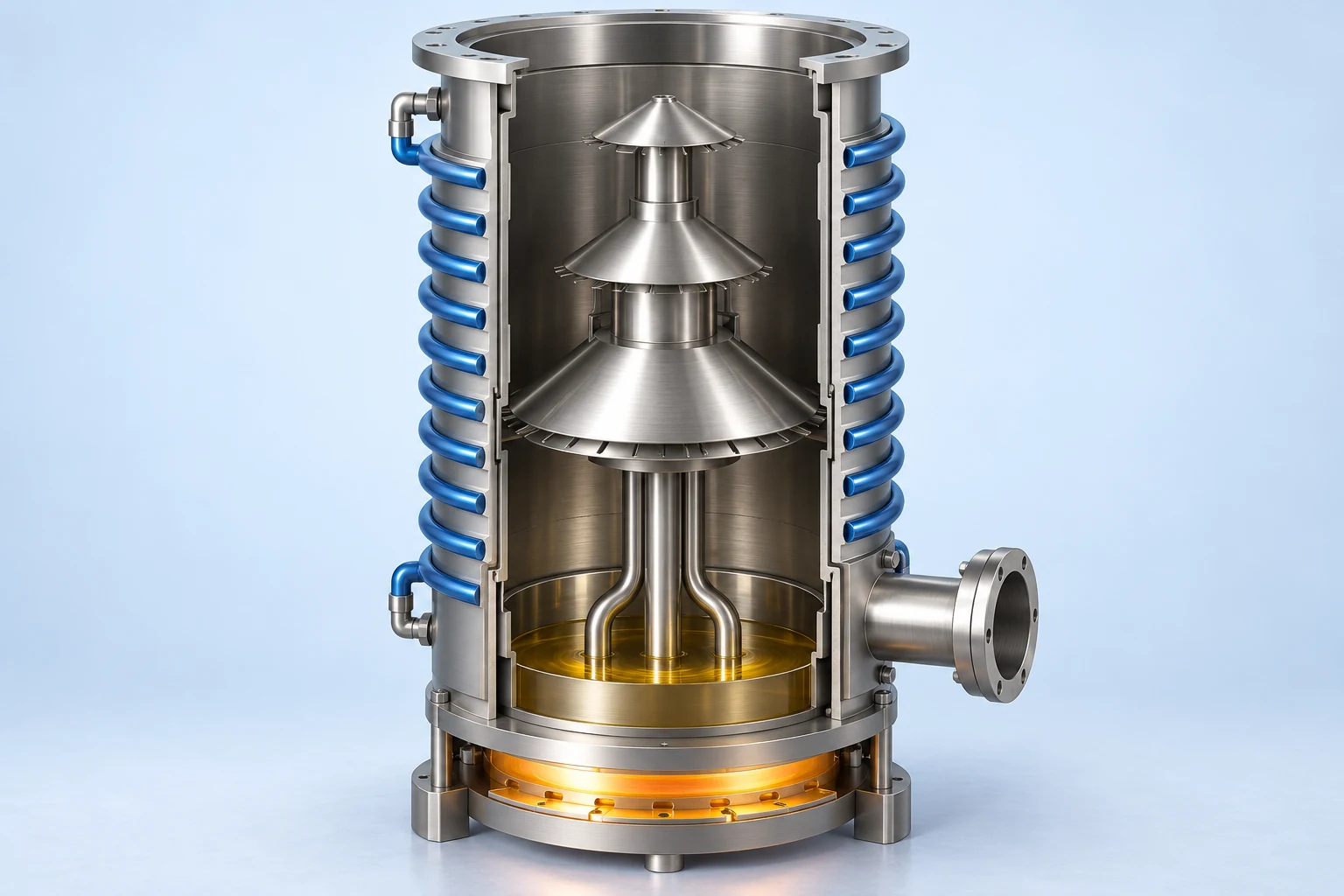
An oil diffusion pump uses a heated working fluid and a multistage nozzle assembly rather than a rotating impeller. Vapour rises through the jet structure and leaves the nozzles at high velocity. Momentum transfer carries gas molecules toward the lower pumping stages and the foreline, where a backing pump removes them. The diffusion pump therefore forms part of a pumping system; it does not discharge directly to atmosphere. [1]
The working-fluid loop is different from the gas-removal path. Vapour condenses on the cooled casing and returns to the boiler, while the gas being evacuated continues toward the backing line. Heater condition, fluid condition and cooling performance all influence this arrangement. A clean-looking outer shell reveals little about the condition of the internal jet stack or the suitability of the operating controls.
Why pump speed is not chamber pumping speed
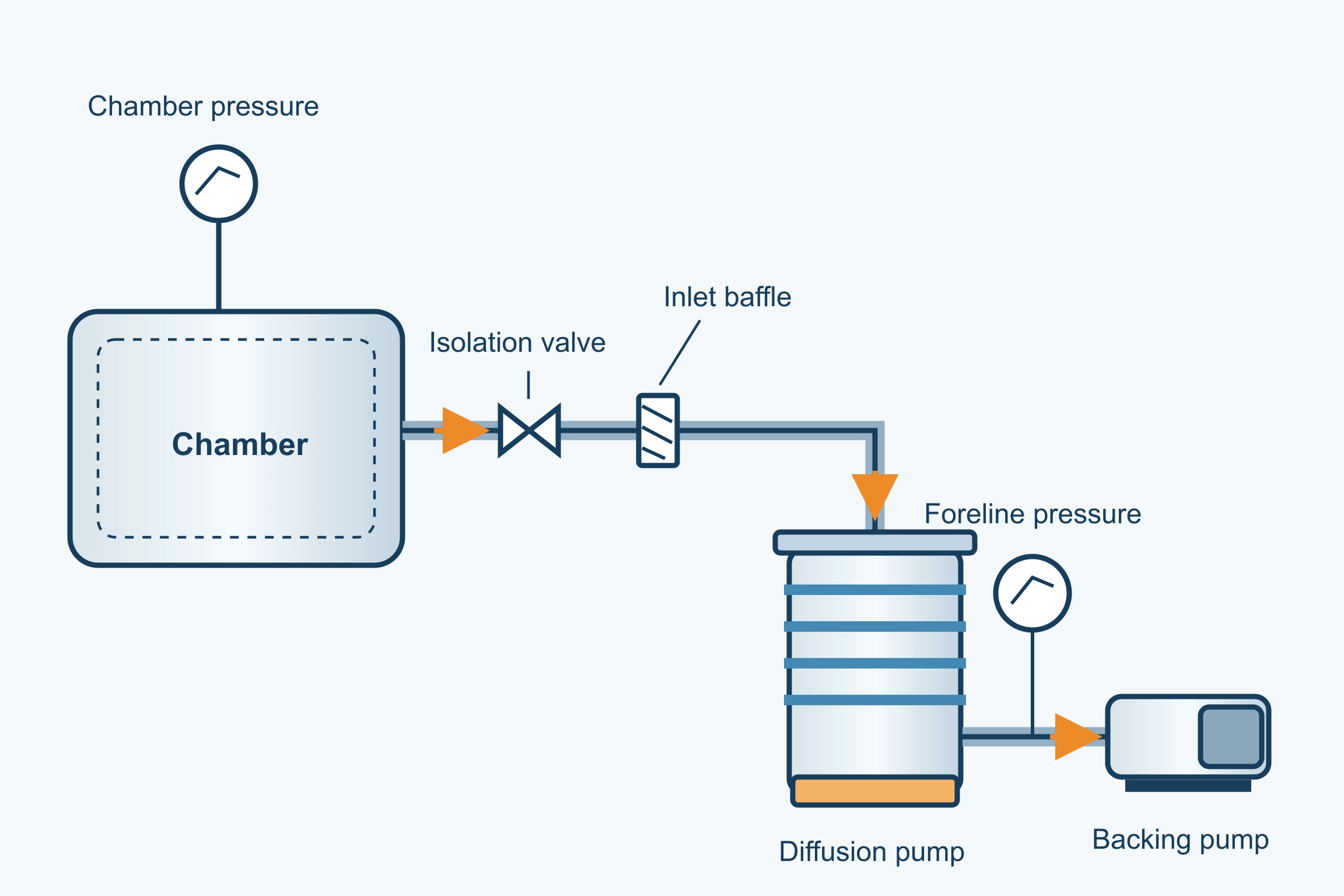
Gas must pass through the furnace connection, valves and any inlet baffle before reaching the pump. These components introduce flow resistance, so effective pumping speed at the chamber is lower than the pump's inlet rating. Conductance also depends on the gas and flow regime. A pump comparison is incomplete unless the quoted inlet arrangement and test conditions are identified. [2]
For a proposed replacement, ask for the complete connection layout rather than comparing flange size alone. A restrictive adapter or an additional baffle can change the result. Check backing-pump capacity and foreline conditions separately: an acceptable chamber reading does not, by itself, establish that the diffusion pump is operating within its backing-pressure limits.
When specifying a vacuum brazing furnace system, provide the intended load and process stages as well as the vacuum target. Empty-chamber and loaded-cycle records should be identified separately, with gauge location, starting conditions and the fitted pumping arrangement retained in the report.
Assess hardware improvements by function
Useful developments include better control of vapour migration, more maintainable heating arrangements and clearer operating supervision. For example, commercially documented designs combine an inlet cold cap, a foreline baffle, serviceable heater cartridges and a protective thermostat. Those features are specific to the documented pump family; their presence or performance should not be assumed for every diffusion pump. [3]
A cold cap or baffle should be assessed together with its cooling requirements, access for cleaning and effect on the inlet path. A heater proposal should identify electrical compatibility, heat-transfer arrangement, temperature sensing, replacement access and the response to a failed element. Having several elements is not proof that operating with one failed element is acceptable. That decision belongs to the approved pump design and control specification.
Ask the supplier to distinguish a component substitution from a qualified system upgrade. A different heater controller may require changes to wiring, protection, spare parts and operating instructions even when the pump vessel remains unchanged. The purchase specification should state who supplies the revised documentation and who is responsible for integrated acceptance. Country of manufacture, heater terminology or a polished casing is not a substitute for this evidence.
Protect the pump throughout operation and shutdown
The protective design must account for stored heat as well as the current electrical command. A heater-off signal does not mean that the boiler is cool or that the pump can safely be vented. Agilent's operating manual requires model-specific preparation and controlled shutdown, including continued cooling and backing during the relevant cooldown period. Hot-fluid exposure to air can create serious hazards. Use the applicable manufacturer's manual and the furnace's approved operating procedure. [4]
A practical engineering review separates the evidence needed to permit operation from the action required after a fault. Cooling flow, relevant temperatures, foreline pressure, valve status and heater condition should have defined responsibilities in the control design. An alarm message alone is not evidence that the necessary protective action has occurred. Identify which signals are measured, which failures are detected, and how the resulting state is confirmed.
This article is an equipment-selection and acceptance guide, not a startup, bakeout or emergency-response procedure. Do not transfer a generic boiler temperature, warm-up duration, crossover pressure or venting sequence to another pump. Qualified personnel must use model-specific limits and approved site procedures; never bypass an interlock to complete a cycle.
During acceptance, review the cause-and-effect matrix and use the supplier's approved test method to verify protective functions without creating an unsafe physical condition. Retain the initial state, simulated input, observed response, reset conditions and responsible sign-off. This creates a useful baseline for later changes to sensors, controllers or utilities.
Build a measurable upgrade acceptance plan
A credible comparison starts before the retrofit. Define the production problem: excessive preparation time, recurring heater replacement, unstable pressure, inconvenient maintenance or high energy use. Then choose measurements that can distinguish that problem from unrelated variation. The following is a proposed buyer's acceptance framework, not a claim about a particular pump or a universal test standard.
| Change under review | Evidence to compare | Decision to record |
|---|---|---|
| Pump or inlet arrangement | Chamber pumpdown curves with the same starting condition, identified gauges, fitted valves and baffles, and comparable loads. | Does the complete arrangement meet the agreed process and cycle requirements? |
| Heater or controller retrofit | Measured electrical energy over a defined operating window, readiness time, pressure stability and logged fault response. | Is any saving retained without reducing pumping performance or protective capability? |
| Cooling or vapour-control components | Utility conditions, monitoring records, installation details and the process-specific cleanliness verification method. | Are cooling capacity, access and contamination controls suitable for the intended application? |
| Maintenance arrangement | Replacement access, compatible spares, documented isolation requirements and comparable post-service pumpdown records. | Can the site restore and verify the system using its actual maintenance resources? |
For energy assessment, record the boundary of the measurement. Pump-heater energy is not the same as total furnace-cycle energy, and installed power is not the same as energy consumed. A lower reading during a short observation window may simply omit warm-up or standby. Compare equivalent duty patterns, record accepted production output and retain the associated quality result. Report the measured scope and uncertainty alongside any percentage improvement.
Maintenance evidence should continue after handover. Agilent's troubleshooting guidance identifies heater input, fluid level, jet condition, cooling and forepressure among relevant checks, and recommends comparing post-maintenance pumpdown behaviour over time. [5] An internal log can tie each intervention to the replaced item, fluid identification, inspection record and subsequent test. Do not treat a successful heater replacement as proof that a chamber leak or process-related gas load has also been resolved.
Specify the pump as part of the brazing furnace
The relevant decision is the pumping configuration for the intended joint, load and production duty. SYNHTE's High-Temperature Vacuum Brazing Furnace page describes a configurable vacuum package in which diffusion or molecular pumping can be added for more demanding high-vacuum requirements. This is an application-dependent option, not a statement that every furnace uses the same pump or that a pump alone guarantees joint quality.
Start the enquiry with materials, filler system, joint cleanliness requirements, load envelope, fixture information and the proposed process cycle. Include the present pressure-time trace if a retrofit is being considered. Then separate required operating performance from acceptance evidence: the first defines what the system must achieve, while the second defines how both parties will know it has been achieved.
A useful handover package links the approved configuration to drawings, utility requirements, operating limits, protective functions, maintenance instructions and recorded tests. Changes made during commissioning should be reflected in that package before routine operation. For a review of the appropriate furnace and pumping interfaces, share the application and existing system information with SYNHTE.
Evaluate the hot zone, vacuum package, controls and maintenance access together. A diffusion-pump selection should support the brazing application and the site's operating resources. Model-specific specifications and acceptance limits belong in the agreed technical proposal, not in a generic article illustration.
High-Temperature Vacuum Brazing Furnace
Discuss a configurable furnace and vacuum package for the specified materials, joint requirements and production load.
- Identify the required working conditions and vacuum-test basis.
- Review pump, valve, cooling and control interfaces together.
- Agree on documentation, spare parts and acceptance responsibilities.
What to include in your enquiry
For a focused engineering review, provide the following available information and mark unknown items rather than estimating them.
- Materials, filler, joint or assembly drawing, load mass and fixture arrangement.
- Required temperature cycle, pressure target, cleanliness criteria and production rate.
- Existing pump model, inlet and foreline layout, backing-pump configuration and utilities.
- Recent chamber and foreline trends, maintenance history and the problem to be corrected.
- Requested performance evidence, site constraints and responsibility for final acceptance.
Technical references
- Leybold: oil diffusion vacuum pumps — vapour-jet operating principle and cooled-wall condensation.
- Leybold: vacuum conductance fundamentals — connection losses and effective pumping speed.
- Leybold: DIFFVAC DP design features — a documented example of cold-cap, heater and protective-thermostat arrangements.
- Agilent: High Throughput Diffusion Pumps instruction manual — model-specific operating and shutdown precautions.
- Agilent: Maintenance and Troubleshooting of Oil Diffusion Pumps — maintenance records and diagnostic checks.