Material and binder
Identify feedstock chemistry, binder composition, expected mass loss and contamination limits.
Configure one furnace platform for powder metallurgy, MIM, carbide, ceramic and refractory-metal sintering. Select the hot zone, chamber, vacuum system and atmosphere to match your material and production cycle.
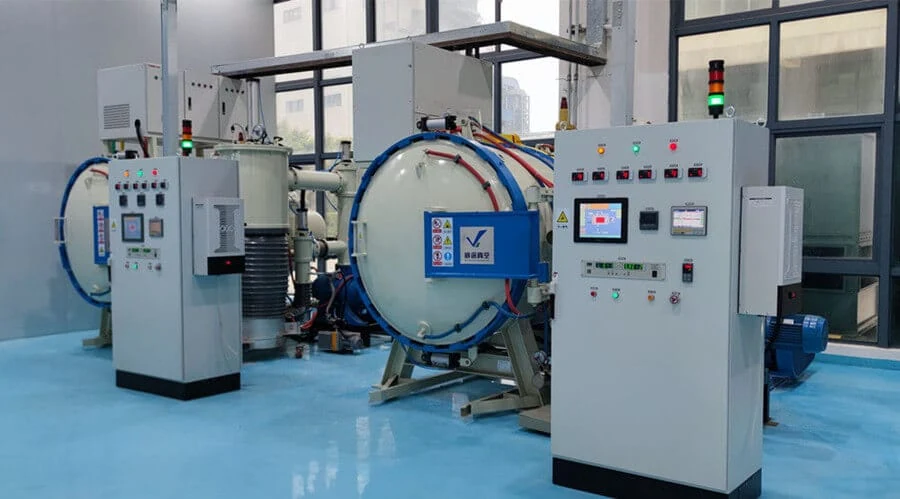
Multiple chamber sizes, hot zones and vacuum systems are available for material- and process-specific configuration.
Start with the production load and material chemistry, then match the hot zone, vacuum and gas route, cooling and controls.
Identify feedstock chemistry, binder composition, expected mass loss and contamination limits.
Define the part, tray or setter, usable work-zone envelope and total production-load mass.
Set peak temperature, vacuum level, gas stages, hold times and graphite or molybdenum compatibility.
Confirm throughput, cooling route, density, shrinkage, chemistry, defect and data-record requirements.
A shared furnace platform can support several process families through matched hot-zone materials, trays, binder-vapor handling, cleaning and gas systems. For mixed production, SYNHTE plans changeover and cross-contamination controls around the material combination.
Select the chamber size, load capacity, hot zone, vacuum system and atmosphere to match your material, production load and cycle requirements.
| Selection item | Configuration range | Selection basis |
|---|---|---|
| Effective work zone | 300 × 300 × 450 to 800 × 800 × 1200 mm | Match the part, fixture or tray and production-load envelope. |
| Loading capacity | 100 to 800 kg | Include trays, fixtures and setter mass—not parts alone. |
| Heating power | 60 to 210 kW | Match the hot zone, load, ramp requirement and utilities. |
| Maximum temperature | 1300°C molybdenum / 2200°C graphite | Choose by material chemistry, peak temperature and hot-zone compatibility. |
| Vacuum | 4 × 10⁻³ Pa ultimate | Confirm the required process pressure, binder load and pumping route. |
| Atmosphere | N2 / Ar / H2 / mixed-gas options | Confirm material, binder, purity and safety requirements. |
| Temperature performance | ±5°C uniformity / ±1°C control | Define the qualified work zone, survey method and operating condition. |
| Pressure rise | 0.5 Pa/h | Match the isolation time, starting pressure and test condition. |
Share the material, load and target cycle with SYNHTE to receive a matched furnace configuration and FAT/SAT plan.
Send the material, usable work zone, total load and target cycle for chamber, hot-zone and pumping-system recommendations.
The two primary hot-zone routes serve different temperature and compatibility needs. Pumping, gas supply, fixtures and binder-vapor management are then configured around the selected route.
The platform can be configured for vacuum processing or nitrogen, argon, hydrogen or mixed-gas stages. Gas purity, flow, pressure control and safety systems are matched to the material and recipe.
For binder-bearing feedstock, the system can include an integrated binder-removal module plus traps, condensers and filters. Binder composition, mass-loss route and cleaning frequency are required design inputs.
Water cooling, gas cooling, PLC control, recipe storage, process curves, alarms and data records are available configuration items. Cooling time and gas demand depend on the load and allowable temperature gradient.
Horizontal or vertical chamber arrangements, custom trays, setters and loading systems can be matched to the work-zone envelope and handling plan.
The multipurpose platform offers broad batch flexibility. Dedicated furnace architectures are available for pressure-assisted sintering, heavy bottom loading, intensive binder management and hydrogen tube processing.
Choose the dedicated MIM page when binder removal, vapor management and repeat production are central to the project.
Compare MIM configuration →When axial pressure is applied during the thermal cycle, use the dedicated hot-press furnace selection path.
Compare hot-press configuration →The bottom-loading platform simplifies dedicated handling for large, tall or heavy production loads.
Compare bottom-loading configuration →The atmosphere tube furnace supports hydrogen heat treatment or sintering with dedicated gas and safety systems.
Compare hydrogen tube configuration →Use the commercial hub to compare chamber arrangements and specialized sintering furnace families before fixing the project route.
Open the sintering furnace hub →Keep this route when several compatible vacuum or protective-atmosphere recipes need one configurable chamber and controlled changeover.
Send the process matrix →Share the material, load, temperature, atmosphere and throughput so SYNHTE can compare the multipurpose and dedicated furnace routes.
SYNHTE can document thermal performance, vacuum, gas control, recipes, alarms and interlocks through a project-specific FAT/SAT plan.
It is a configurable batch-furnace family rather than one fixed recipe. The chamber, hot zone, pumping system, gas route, cooling, controls and optional binder-removal equipment are selected around compatible material and production routes.
Start with the required peak temperature, material chemistry and contamination limit. The available maximum is 1300°C with a molybdenum hot zone and 2200°C with a graphite hot zone. Fixtures, gases and cross-contamination limits are matched to the selected route.
An integrated debinding module is available. The package is selected from the binder composition, total mass loss, vapor route, traps, condensers, filters and cleaning plan. A dedicated MIM furnace is also available when binder management is the primary production requirement.
Provide the full part, tray, setter or fixture envelope and the total hot load. Available effective work zones range from 300 × 300 × 450 to 800 × 800 × 1200 mm, with loading capacities from 100 to 800 kg.
Hydrogen and mixed-gas systems are available. SYNHTE matches material compatibility, gas purity, operating pressure, exhaust treatment and safety systems to the process and site utilities.
With the inputs below, SYNHTE can match the chamber, hot zone, pumping, gas, cooling and controls to the application and prepare a clear FAT/SAT acceptance plan.
Discuss your sintering processDownload the current reference document or compare all available SYNHTE technical resources.