Why Vacuum Brazing Defects Still Occur
Vacuum brazing is widely regarded as one of the cleanest and most reliable joining methods.
However, in real production environments, defects still occur.
Even with advanced equipment, manufacturers may encounter issues such as:
- leakage
- incomplete joints
- deformation
- inconsistent quality
In most cases, these problems are not caused by the furnace itself, but by:
- process parameter deviation
- improper preparation
- material mismatch
- insufficient process control
Understanding the root causes of these defects is the key to improving production yield.
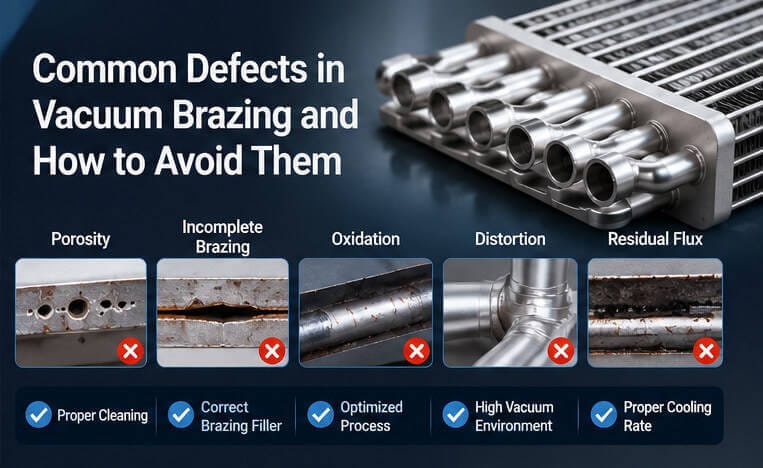
1. Incomplete Brazing / Poor Joint Filling
Symptoms
- gaps not fully filled
- visible discontinuities
- weak bonding areas
Common Causes
- insufficient brazing temperature
- holding time too short
- improper joint clearance
- poor filler metal flow
How to Avoid
- optimize temperature profile
- ensure proper soaking time
- control joint gap (typically 0.02–0.1 mm)
- select suitable filler material
In practice, joint design plays a larger role than many expect.
2. Porosity and Voids
Symptoms
- small cavities inside joints
- reduced mechanical strength
- potential leakage paths
Common Causes
- trapped gases
- surface contamination
- improper vacuum level
- rapid heating
How to Avoid
- improve cleaning process
- ensure sufficient vacuum level
- use controlled heating rates
- avoid trapped air during assembly
For heat exchangers, even micro-level porosity can become a critical issue.
3. Leakage (Especially in Heat Exchangers)
Symptoms
- pressure test failure
- fluid leakage
- unstable system performance
Common Causes
- incomplete brazing
- micro-cracks
- porosity
- contamination in joints
How to Avoid
- perform leak testing after brazing
- improve surface cleanliness
- optimize filler distribution
- ensure uniform heating
Leakage is one of the most critical defects in cooling systems and often leads to product rejection.
4. Poor Wetting of Filler Metal
Symptoms
- filler metal does not spread properly
- uneven joint coverage
- weak bonding
Common Causes
- oxide layers on material surface
- incorrect filler metal selection
- insufficient temperature
- contamination
How to Avoid
- improve surface cleaning
- use compatible filler metals
- ensure proper vacuum conditions
- adjust brazing temperature
This issue is especially common in aluminum brazing due to its natural oxide layer.
5. Distortion and Deformation
Symptoms
- dimensional changes
- warped components
- misalignment after brazing
Common Causes
- uneven heating
- improper fixture design
- rapid cooling
- material thickness differences
How to Avoid
- improve fixture stability
- use uniform heating profiles
- control cooling rate
- optimize part design
For precision parts, distortion can result in additional machining or even scrap.
6. Oxidation and Surface Discoloration
Symptoms
- surface darkening
- oxide formation
- reduced joint quality
Common Causes
- insufficient vacuum level
- gas leakage
- contaminated furnace environment
How to Avoid
- maintain vacuum system properly
- check seals and leakage points
- ensure clean furnace chamber
Vacuum quality directly affects surface condition.
7. Excessive Filler Flow or Overflow
Symptoms
- excessive filler metal accumulation
- blockage in flow channels
- poor appearance
Common Causes
- excessive filler material
- improper joint design
- overheating
How to Avoid
- control filler quantity
- optimize joint clearance
- adjust temperature profile
In microchannel heat exchangers, overflow can block internal passages.
8. Weak Joint Strength
Symptoms
- joints fail under load
- reduced mechanical performance
Common Causes
- poor metallurgical bonding
- contamination
- incorrect process parameters
How to Avoid
- ensure proper brazing temperature
- improve cleaning
- select appropriate filler metal
Why Most Defects Are Process-Related
A key observation in industrial production:
More than 70% of brazing defects are caused by process control issues rather than equipment limitations.
Common problem areas include:
- inconsistent cleaning
- unstable vacuum levels
- improper temperature curves
- lack of standard operating procedures
This is why experienced manufacturers focus heavily on process standardization.
Best Practices to Reduce Defects
To achieve stable and repeatable results:
- standardize cleaning procedures
- control joint design tolerances
- use validated temperature profiles
- maintain vacuum system regularly
- implement inspection and testing protocols
For mass production, consistency is more important than peak performance.
Typical High-Risk Applications
Defect control is especially critical in:
- aluminum heat exchangers
- EV battery cooling plates
- aerospace components
- liquid cooling systems
- precision industrial assemblies
In these applications, even small defects can lead to failure.
Final Thoughts
Vacuum brazing is a highly reliable process—but only when properly controlled.
Most defects can be avoided by:
- improving preparation
- optimizing parameters
- maintaining equipment
- standardizing processes
For manufacturers, reducing defects means:
- higher yield
- lower cost
- better product reliability
Understanding these common issues is the first step toward achieving stable, high-quality production.