Why Choosing the Right Vacuum Furnace Is Critical
Selecting a vacuum furnace is not simply a matter of choosing a temperature range or chamber size.
In practice, the wrong selection can lead to:
- inconsistent product quality
- excessive deformation
- low production efficiency
- unnecessary operating costs
For many manufacturers, the biggest issue is not equipment quality—but mismatch between furnace configuration and actual application.
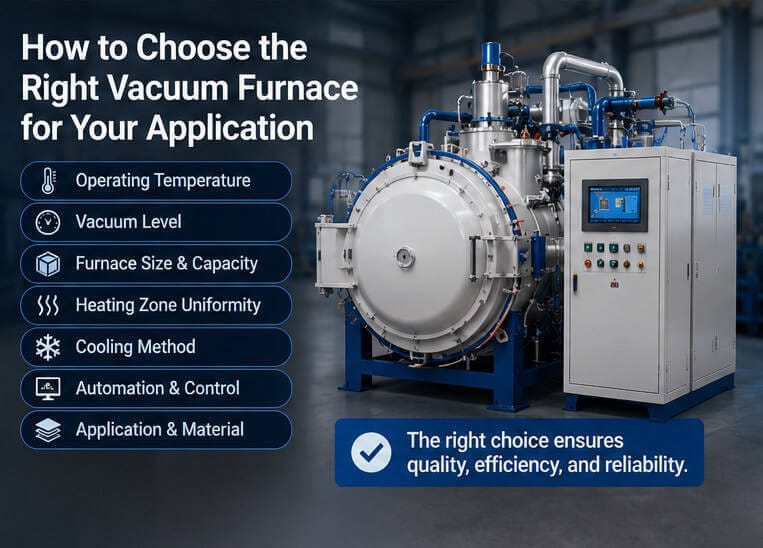
Understanding how to choose the right vacuum furnace is essential for achieving stable, repeatable, and cost-effective production.
Step 1: Define Your Primary Process
The first and most important step is to clearly identify your process.
Different processes require fundamentally different furnace configurations.
Common vacuum furnace applications include:
- vacuum brazing
- vacuum heat treatment (quenching, tempering, annealing)
- vacuum sintering
- degassing
- diffusion bonding
Each process has different requirements in terms of:
- temperature range
- heating method
- cooling system
- vacuum level
Example:
- Aluminum brazing→ requires precise temperature control and clean environment
- Tool steel quenching→ requires rapid cooling capability
- Powder metallurgy sintering→ requires high temperature stability
Choosing the wrong furnace type at this stage can create long-term production limitations.
Step 2: Identify Material Requirements
Material type directly affects furnace configuration.
Different materials react differently under vacuum and high temperature.
Typical materials include:
- stainless steel
- carbon steel
- aluminum alloys
- titanium alloys
- nickel-based superalloys
- ceramics and powder materials
Key considerations:
- oxidation sensitivity
- melting temperature
- thermal expansion
- reaction with furnace materials
Example:
- Aluminum→ requires strict control to avoid oxidation and overheating
- Titanium→ requires high vacuum and contamination-free environment
- Superalloys→ require high-temperature capability
Material compatibility is often overlooked, but it is critical for long-term performance.
Step 3: Determine Required Temperature Range
Temperature capability is one of the most visible specifications—but also one of the most misunderstood.
Typical ranges:
- up to 700–800°C → aluminum brazing / low-temp processing
- up to 1300–1350°C → general heat treatment
- up to 1600–2200°C → sintering / advanced materials
Important note:
Do not select a furnace that operates at its maximum temperature continuously.
A safety margin is necessary for:
- temperature stability
- equipment lifespan
- process consistency
Step 4: Evaluate Heating Chamber Type
The heating chamber (hot zone) plays a critical role in performance.
Common options:
Graphite Heating Chamber
- suitable for high temperatures
- good thermal efficiency
- widely used in sintering
Metal Heating Chamber (Mo / W)
- cleaner environment
- suitable for bright heat treatment
- preferred for stainless steel and precision parts
Selection depends on:
- material compatibility
- temperature range
- cleanliness requirements
Step 5: Choose the Right Cooling Method
Cooling is just as important as heating.
Different processes require different cooling rates.
Common cooling options:
- vacuum cooling
- inert gas cooling (N₂ / Ar)
- high-pressure gas quenching
- oil quenching (for certain steel applications)
Example:
- Tool steel→ requires rapid quenching
- Precision parts→ require controlled cooling to reduce distortion
- Sintered materials→ require slow cooling
Incorrect cooling selection can lead to:
- cracking
- distortion
- poor mechanical properties
Step 6: Consider Production Volume and Automation
Production scale affects furnace type.
Batch Furnace
- flexible
- suitable for multiple product types
- lower initial cost
Continuous Furnace
- high efficiency
- suitable for mass production
- consistent quality
Automation considerations:
- automatic loading/unloading
- conveyor systems
- PLC control
For large-scale manufacturing, automation significantly improves productivity.
Step 7: Vacuum System Configuration
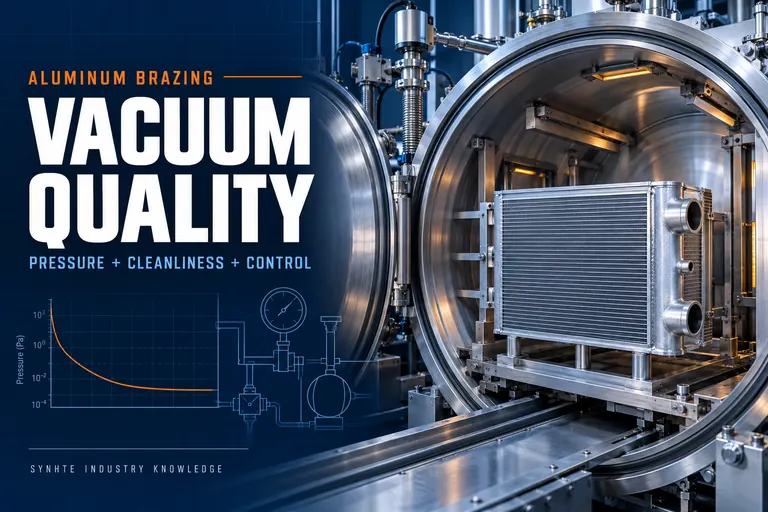
Vacuum level is critical for process quality.
Typical configurations:
- rotary pump (basic vacuum)
- diffusion pump (high vacuum)
- molecular pump (ultra-high vacuum)
Selection depends on:
- material sensitivity
- process requirements
- cleanliness level
Higher vacuum levels help:
- reduce oxidation
- improve surface quality
- enhance bonding strength
Step 8: Control System and Process Repeatability
Modern vacuum furnaces rely heavily on control systems.
Key features to consider:
- programmable temperature curves
- multi-zone temperature control
- PID precision control
- data logging and traceability
Stable control ensures:
- repeatability
- consistent product quality
- easier process optimization
Step 9: Customization and Future Flexibility
Many buyers focus only on current needs.
However, future flexibility is equally important.
Consider:
- chamber size expansion
- additional gas systems
- upgraded cooling capability
- automation upgrades
A flexible system reduces long-term investment risk.
Common Mistakes When Choosing a Vacuum Furnace
In real projects, the most common mistakes include:
- selecting based only on price
- ignoring process requirements
- underestimating cooling needs
- choosing insufficient temperature range
- lack of future scalability
Avoiding these mistakes can save significant cost over time.
Typical Application-Based Recommendations
For Heat Exchanger Manufacturing
- aluminum vacuum brazing furnace
- precise temperature control
- clean environment
For Tool Steel Processing
- vacuum quenching furnace
- gas or oil cooling
- strong temperature uniformity
For Powder Metallurgy / MIM
- high-temperature sintering furnace
- controlled atmosphere
- long holding capability
For Aerospace Components
- high vacuum level
- metal hot zone
- strict process control
Final Thoughts
Choosing the right vacuum furnace is a technical decision that directly affects:
- product quality
- production efficiency
- operational cost
- long-term reliability
The best solution is not the most expensive one—but the one that matches:
- your process
- your materials
- your production goals
A well-matched system can significantly improve both product performance and manufacturing efficiency.