
Design vacuum brazing vent paths for blind holes and enclosed...
Read MoreIn modern manufacturing, tool steel is widely used for components that must withstand high pressure, repeated impact, friction, and elevated temperatures.
Typical applications include:
The service life of these components is determined not only by the steel grade itself, but also by the quality of the heat treatment process.
Among all thermal processing methods, vacuum heat treatment has become the preferred solution for high-performance tool steel applications.
Research shows that optimized vacuum heat treatment can significantly improve hardness, fracture toughness, and wear resistance, directly extending tool service life.
Vacuum heat treatment refers to performing thermal cycles inside a sealed chamber under high vacuum or controlled gas atmosphere.
Typical processes include:
Unlike traditional atmosphere furnaces, vacuum systems remove oxygen and reactive gases during heating.
This helps prevent:
For tool steel, surface integrity is critical because even minor oxidation can affect dimensional accuracy and coating adhesion.
The most direct benefit of vacuum heat treatment is improved hardness.
For common tool steels such as:
vacuum quenching creates a stable martensitic structure with controlled carbide distribution.
This significantly improves:
Studies on high-speed steel confirm that vacuum heat treatment markedly improves wear behavior and cutting performance.
This is especially important for:
For molds and dies, failure is usually caused by:
Vacuum heat treatment improves both hardness and toughness balance.
This balance is critical.
A die that is too hard may crack.
A die that is too soft wears rapidly.
Proper vacuum quenching + tempering helps optimize:
Research indicates that correct vacuum heat treatment parameters significantly improve load-carrying capacity and fatigue life of hot-work tool steels.
One of the biggest concerns for tool steel customers is distortion.
This is especially critical for:
Vacuum furnaces provide:
This minimizes dimensional change after hardening.
Compared with salt bath or conventional furnaces, vacuum systems provide much better repeatability.
This directly reduces:
Modern tool steels are often combined with:
Vacuum heat treatment preserves a clean, bright surface.
This improves coating adhesion and overall coating life.
Studies show that vacuum-treated substrates provide better support for coated tool surfaces under high-load applications.
This is extremely important for:
Vacuum heat treatment is widely used for:
More manufacturers are switching to vacuum systems because they provide:
For large-volume mold and tool production, this creates clear economic advantages.
For tool steel components, material grade alone is not enough.
The real difference in service life often comes from the heat treatment process.
Vacuum heat treatment delivers the optimal combination of:
This is why it has become the standard solution for modern molds, dies, and cutting tools.
Design vacuum brazing vent paths for blind holes and enclosed...
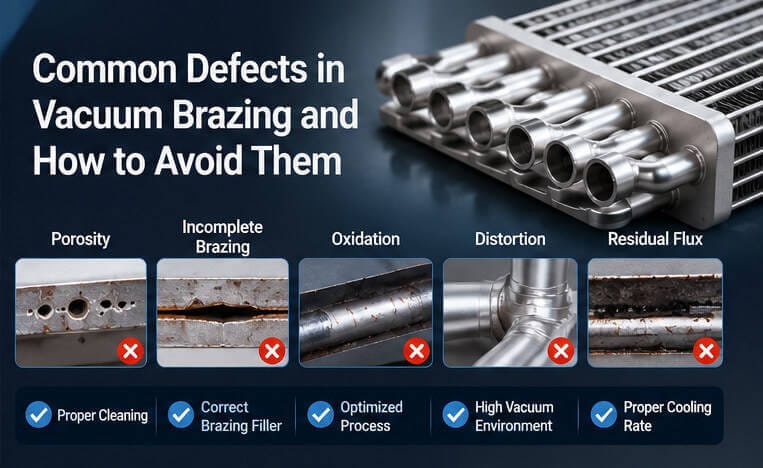
Read MoreLearn the most common defects in vacuum brazing, including voids,...
Read MoreQualify vacuum oil quenching load immersion through transfer control, basket...
Read MoreMultipurpose Vacuum Sintering Furnace for High-Temperature Precision Sintering and Debinding...
Read MorePressure-Assisted Vacuum Joining Platform VTM Vacuum Diffusion Bonding & Brazing...
Read MoreVTSL vertical bottom-loading platform VTSL Bottom-Loading Vacuum Sintering Furnace A...
Read More